Showing posts with label arthur herzog. Show all posts

Thursday, July 30, 2026

FOOTPRINTS ON THE SANDS OF TIME by L.M. Lewis


You might think that 1975 is getting a little late in the game (after the gold rush, even) for yet another bold type, going-beyond-Chariots-of-the Gods? blurbed Ancient Astronauts piece, but author L.M. Lewis tells us he's been working on the mystery behind THE MASTER RACE for years, and far be it from us to deny him sharing the fruits of his life's work ...

Looking back fifty years later, despite Lewis' frequent invocation of the MASTER RACE that came from the stars and gifted humanity with our civilizational uplift, thankfully this isn't another Holocaust denyin' or otherwise fascistic work. Frankly, Lewis comes out far ahead of von Daniken in this regard. No, this is enjoyable, pure crank writing - Lewis has pegged the arrival of the MASTER RACE to exactly 6790 BC, and walks us through his maths as the enlightened ones from outer space interact with burgeoning human societies, ultimately taking their leave in 1451 BC for reasons Lewis will also elucidate ...


We've seen all this before, of course: Ezekial's wheel was a UFO, Sodom and Gomorrah were nuked, the pyramids were built by aliens - or, more properly in this case, inspired by aliens, as Lewis gives the Egyptians full credit for the hard work, albeit in an outdated way as he believes they relied on slave labor for the feat. Anyways, the point is that Mr. Lewis presents some tried and true Ancient Astronaut grist in an engaging manner, all killer no filler. Let the man speak for himself:

In 1970 the author became convinced that (1) the Master Race landed on this planet in 6790 B.C., with as much wheat as they could conveniently carry. (2) Quickly establishing themselves, they multiplied their stocks by two harvests a year - one natural, the other artificial - for five years. (3) With an eye to the future, they instructed the Egyptian nomads (who began to settle down two years later, namely in 6783 B.C.) in the growing of wheat and in agriculture. Villages and towns began to grow up, and officials of the Master Race guided the affairs of the infant nation for the next forty-nine years- "when gods ruled Egypt"! (4) Members of the new nation taken gradually into the government as they progressed (in 6770 в.c.) wished to build the biggest monument ever to the freedom they had been promised within fifty years. (5) The Master Race agreed to supply the brains and "know-how," the Egyptians, the materials and labor, which the Master Race would control. As stated earlier, Memphis was founded and work started on the great road in 6764 B.C.

By these calculations, it will be observed that the coming of the Master Race, the founding of Memphis, and the building of the Great Pyramid, all took place in the seventh century before the Flood.

History is full of the manifestations of novel ideas, unusual happenings, and unlooked-for results, all of which make it stranger than fiction! How many decisive battles have been won and lost. How many great men have stepped upon the mighty stage of Earth's affairs for one brief day of glory that at evening passed away. Some names will always be remembered, but they are few in number. Undoubtedly the most amazing is Jesus Christ - that astounding young man who put the world on fire, whose memory has often changed the intentions of mankind, and whose words, after nearly 2,000 years, are still a living power! Because he lived - and died - even man's reckoning of time has changed.
Lewis is fond of lists and summaries. Compare this to W. Raymond Drake's endless and interminable series of Gods And Spacemen from hither and yon as featured in the opening ad page. By the time Drake has gotten around to Gods and Spacemen in East Lansing, Michigan, Lewis has already said his piece and retired to a sensible evening after this one and done title.


No quickie cash-in huckster he, it's only right to give Lewis the final word as well:
Poised on the brink of a third and final world war, the nations of mankind stare enviously at each other in mutual fear, akin to mesmeric terror. How much time will elapse before the seemingly inevitable happens and the nations again start murdering their neighbors?

No! Don't deny the fatal probability. As an unbiased and logical person, take a good look for yourself at the world of today. The peoples of the Earth stand armed to the teeth! The majority are half-starved, because the world's substance is being squandered on hydrogen bombs, ballistic missiles, nuclear submarines, poison gas, and offensive germ cultures. All this is in the cause of "defense," of course! What utter stupidity!

If these international propensities were manifested in individuals rather than by nations, we should be well justified in immediately incarcerating them in a criminal lunatic asylum!
If it's not too late, Footprints on the Sands of Time is available to read and download at archive dot org.

Signet Books, 1975

Thursday, November 14, 2024

EARTHSOUND by Arthur Herzog


The DISASTERTHON smashes on! Tonite, we feel the earth move under our feet as disaster maven Arthur Herzog scribes us the EARTHSOUND!


Your name is Harry Vail. You have a tragic backstory involving the Good Friday earthquake of 1964 which struck Alaska with a vengeance - maybe this would have been a gripping story on its own, but you've moved to Rhode Island with your new wife and live a quiet life as a geological surveyor, mixing with the beautiful people and secure in the knowledge that the East Coast's staid tectonics won't reignite your trauma ...

Or won't they?

Herzog makes a bold play here, eschewing LA, Japan, or even NYC in favor of a small town tableau, mixing folk horror with the classic disaster formula. The results are uneven but interesting, as Harry Vail must navigate the treacherous ground of an insular New England community as he tries to unravel the burgeoning threat from below. Midcentury bourgeois angst blends uneasily with the frisson of nature's fury, as nasty party games lead to domestic paranoia and some Stephen King-style conflict with the local dead end youths ... what's the difference, really, between the physical upheaval of an earthquake and the shifting ground of a failing marriage, a failing life?


Sadly, Herzog's juicy mixture doesn't quite land on solid ground. There's too many loose ends and dead ends, and the final quake is (rather realistically) limited in scope: there's only so much destruction an isolated peninsula can endure. Threads of poltergeists and Edgar Cayce (Cay-cee, not Case, Herzog helpfully informs us) clutter up the scene without adding much suspense.


Above, the Pan edition, for Commonwealth readers.

Herzog's Earthsound earns 2/4 for an uneven ride with tremors of feeling. Anything is better than nothing! This title is available to read and download at archive dot org.

Signet Books, 1976 (original pub. 1975)

Sunday, February 27, 2022

ORCA by Arthur Herzog


Peter Benchley couldn't have imagined the tidal wave of derivative terror he'd unleash after the publication of his Jaws in 1974, but in the wake of the blockbuster film adaptation in '75 a legion of Hollywood hacks and pulp fiction scribblers were soon swarming like ... well, like sharks, in a feeding frenzy over a newly revived genre based in an age old terror of the sea and handed down fishermen's tales of impossible, implacable monsters. And soon enough, among the schools of sharks, other denizens of the deep were being dredged up to serve as villains: piranha, giant octopus, plesiosaurs (and monster birds). 

Enter Italian mega-producer Dino de Laurentiis, who tasked his filmmakers to "find a fish tougher and more terrible than the great white" in order to take a bite of that boffo benthic box office.

Enter the killer whale. Truly an awesome beast, though some dramatic liberties were taken in adapting Orcinus orca for the big screen. To whit, the oft-repeated blurb about the orca's vengeance drive, featured in the film's trailer, poster, and on the back cover above, and some old fishwives' tales of orcas eating human prey. This was the Wild West era of marine biology, when myth still mingled with scientific methodology in the popular mind. All the more appropriate that the filmed version of Orca climaxes amid a patently phony landscape of styrofoam icebergs filmed in sunny, balmy Malta. But we're here for the novelization, and such budgetary shortfalls shouldn't concern us on the printed page. In fact, Herzog delivers a riveting climax for his novel, though there's some rough seas getting there.


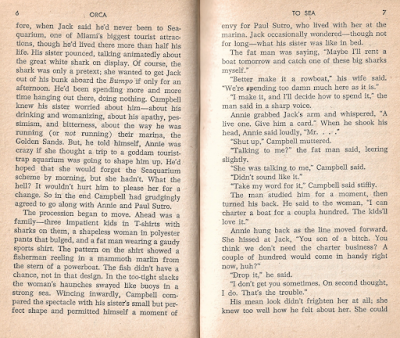
If anyone could pull off a rote adaptation of a mercenary genre flick, it seems like it'd be author Arthur Herzog, previously responsible for the killer bee catastrophe The Swarm, which ended up adapted by Irwin Allen for one of his late-career bombs in 1978. But here he almost bungles things right out of the gate! The first chapter is a complete waste, pure filler with salty dog Jack Campbell, his sister Annie, and her beau Paul taking a trip to the aquarium to see a stuffed shark and a performance by a pair of orcas. It's a deadly dull way to begin a thriller about death on the high seas - we're stuck in suburban Miami, for Chrissakes, when we should be feeling the spray on our face and the ocean roll under our feet! Jack fantasizes about his sister's sex life with her boyfriend in some typical '70s weirdness, sizes up some unattractive tourists, and listens to a very unscientific spiel about orcas from the show trainers, complete with the invented orca vengeance drive and spurious tales of human consumption. We're also gifted some early editing gaffes, with a "great white" accidentally described as a "great whale" on page five. Things aren't looking good here.

But slowly, surely, Herzog builds up a head of steam. Once we're witness to a shark bitten in half (take that, Jaws!), the first, disposable crewman chowed down on, and an orca miscarriage all in one go, we're off to the races! I'm not sure if Herzog was working with an earlier script, or if he perhaps wrote Orca first and then had it snapped up by De Laurentiis for his killer whale movie, but there are a few differences between the book and film. The pointless first chapter in Miami is thankfully absent from the film, and the character of Annie (played by Bo Derek) isn't related to Campbell as in the book. The climax is different too, with a spoiler following for the book: the whale doesn't kill Campbell! The beast leaves him a broken man adrift on the ice, having lost everything in his futile pursuit - his ship, his crew, his sanity. Now this is some high drama, though the preceding pages were somewhat waterlogged.

3/4

Pocket Books, 1977