Showing posts with label susy smith. Show all posts

Monday, March 31, 2025

ESP AND YOU by Susy Smith


"An incubus is as good an excuse for hanky-panky as has even been invented."

Macfadden-Bartell's classy cover hides one sexy journey into the unknown from that "girl with the improbable name" (I still haven't figured out what that's supposed to mean) Susy Smith, as she uncovers incubi, succubi, ghost lovers, and mass sexual hysteria from the middle ages to modern day suburbia! That's only a part of her exploration of ESP, but man is it a heady brew to lead with.


Smith covers multiple cases of nuns (and Mohammedan girls too!) succumbing to sexual mania, lest we think the literature doesn't support the existence of incubi. Modern housewives and widows aren't immune either, though sometimes Smith says it's hard to tell whether they're being visited by departed lovers or by demons. This is one reason she advises against Ouija boards, as any old demon can call themselves whatever they want when you're pushing the planchette around. She also questions how many "genuine" cases of possession or visitation it really takes to kick off a fad or mania from otherwise unaffected ladies.

Smith carries on with a racy theme through subjects such as ESP in twins, with showgirls Lou and Lee Gerick explaining their psychic connection: once they even purchased identical all white outfits at the same time, despite the two of them being separated in Idaho and Hollywood!

Twins Lou and Lee ... or is it Lee and Lou?

Picture from a 1964 USO show they did.


Their card!

Smith outlines Freud and Jung's ESP experiences, cites heavily from Aldous Huxley's The Devils of Loudun, and interviews a man developing his ESP through LSD under the pseudonym Melvin Mallory. Poltergeists, witches, and vampires all come in for guest roles as well, with Smith very interested in the interplay between psyche, culture, and forces from beyond - how much of any given phenomenon is culturally expressed, or projected out from one's self, or otherwise influenced in ways we might not appreciate?


After so much steamy research, Smith has to assure us that the psychically gifted aren't just a bunch of perverts, though "still, all in all, Nandor Fodor found a lot of psychics who were weirdos!" And there's always Aleister Crowley, too!

According to Fodor's research, Smith tells us that spirits and demons can change one's sexual orientation through possession, leading to lesbianism and homosexuality in heterosexual mediums! Smith also hedges that perhaps these are cases of repressed feelings. Throughout this text, Smith comes back to the idea that no matter what strange forces may be at work, we are all human after all.


Susy includes a nice bibliography in her usual practice, though her discernment as to the quality of various sources may be a bit lacking at times - she admits as much when repeating somewhat shaky stories such as the fraudulent medium Eusapia Palladino, who Smith believes possessed genuine powers while still resorting to trickery from time to time. Sometimes, Smith says, we just can't be sure as to the true facts of a case and can only take people at their word, and she concludes that many of the stories she's covered are just too subjective to prove something one way or the other.

Smith also cites cases and correspondence from her own previous books including World of the Strange, previously reviewed at this blog.

She ends her saucy psychic tour with some final words from author R. Dewitt Miller:


ESP and You is available to read and download at archive dot org.

Macfadden-Bartell Books, 1972

Wednesday, September 25, 2024

HOW TO DEVELOP YOUR ESP by Susy Smith


Whether instant or persistent, from Edgar Cayce to alpha states to Johann C.F. Zollner, Susy Smith's teaching us HOW TO DEVELOP YOUR ESP! Smith melds practical how-to advice with historical background on ESP in her usual professional treatment. Dig that funky vintage cover!

Booze is not recommended for cultivating psychic ability, as it turns out, though shamanistic drugs trips are successfully utilized by the Mixtecos. Smith references Freud and J.B. Rhine's perspectives on the ESP powers of the "primitive" mind, hitting the same notes as Brad Steiger did in his introduction to Warren Smith's Strange Powers of the Mind from 1968. Australian Aborigines, Maori, and "the Kaffirs of South Africa" are some of those peoples blessed with some atavistic connection to ESP. Smith also name checks Walter McGraw's The World of the Paranormal from 1969.


It's a blockbuster presentation, though Smith's credulity lessens the impact somewhat. Earnest attempts at probing the unknown nestle uneasily alongside scammers like "faith healer" Jose Arigo, promoted alongside other psychic surgeon frauds by the gruesome twosome of spooked up writer John G. Fuller and Dr. Andrija Puharich ... more background on Puharich can be found as part of Tanner F. Boyle's audio series on the Starseed phenomenon, which also touches on that old spoonbender Uri Geller. Geller's thankfully absent from Smith's text, as of publication not yet a titan of the paranormal entertainment field. Other vintage psychics like Peter Hurkos and Gerard Croiset do make appearances.


Smith provides a bibliography and index, not always a given for this field, and another reason her writing was a cut above. Despite some caveats, How to Develop Your ESP is a worthy addition to any library of the vintage paranormal.


Pinnacle Books, 1973

Monday, May 6, 2024

COSMIC DEBRIS: Amazing Feats of Komar the Hindu Fakir!


From an online listing for the April 1973 issue of Occult: New Dimensions of Life in the Field of Psychic Phenomena, a slick looking magazine put out by Popular Library, we find an article by Brad Steiger on the performer Komar the Hindu Fakir, aka Vernon Craig. Steiger would use parts of this article as a chapter in his pseudonymous 1974 title The Occult in the Orient, as well as a book called Life Without Pain co-authored with Craig in 1979.


Meanwhile, the striking cover art for Steiger's The Occult in the Orient came from this September 1971 issue of Occult magazine which also promised work by Steiger, as well as Susy Smith:


Issues of Occult magazine are asking hefty prices online, otherwise one may be tempted to see how many recycled Steiger offerings are at hand ...

Popular Library, 1973

Wednesday, March 1, 2023

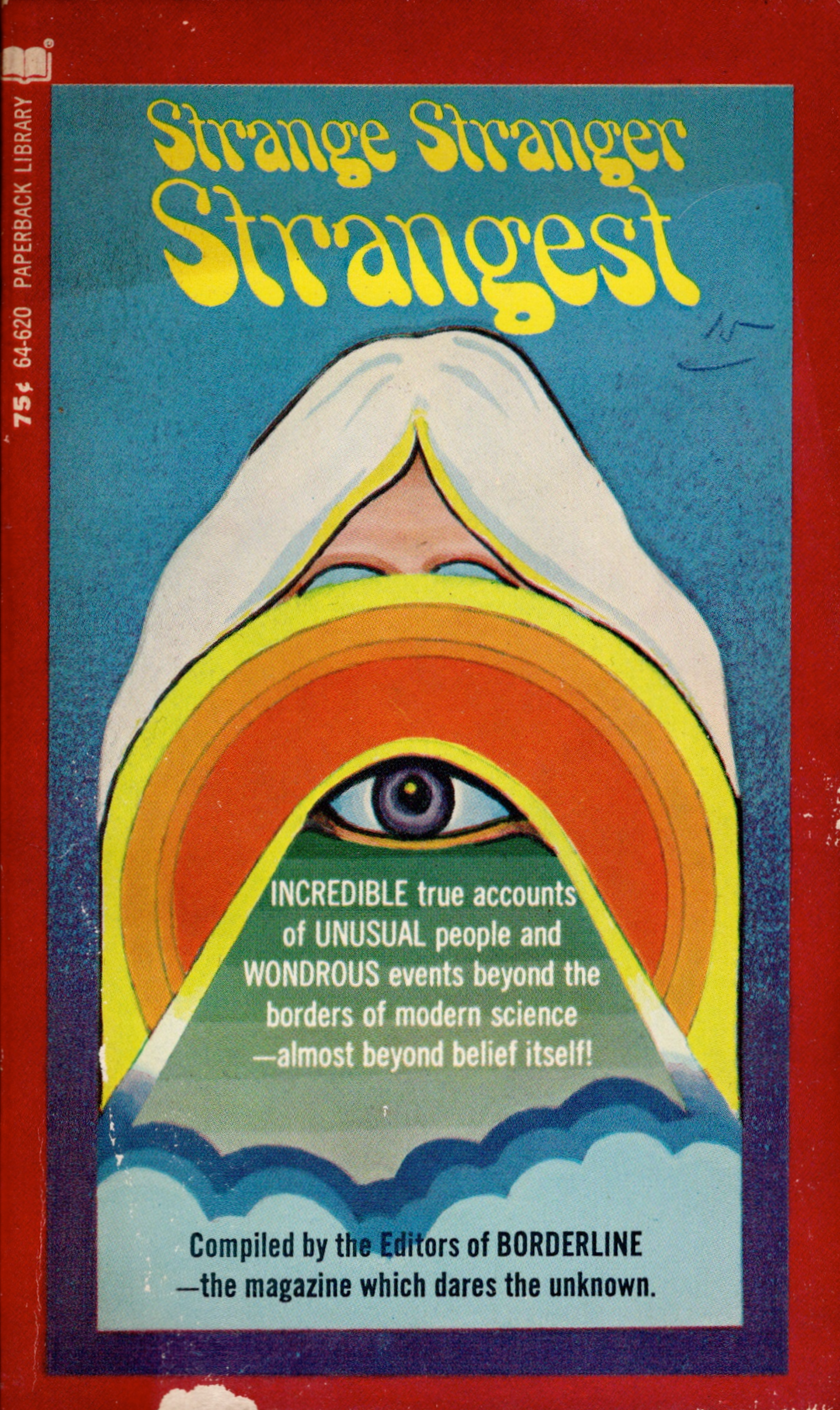
STRANGE STRANGER STRANGEST compiled by The Editors of Borderline Magazine


Stranger than Steiger! Weirder than Warren! More incredible than anything ever published by Christopher Dane or Eric Norman! At least that's the promise ... Compiled by the editors of Borderline magazine, prepare yourself for a journey through things STRANGE, STRANGER, STRANGEST!


Borderline was a short lived competitor to Fate that last only ten issues through 1964-1966, and perhaps for good reason. This title compiles 23 articles representing the best of the best Borderline had to offer, and it's fairly pedestrian stuff. There's no introduction, just a table of contents and then we jump into Joseph Goodavage's tacky article where he claims that he and certain other astrologers were able to predict JFK's assassination. One of "the others" Goodavage refers to is almost certainly superstar psychic Jeane Dixon, who made much hay out of claiming to have foreseen Kennedy's death years prior ... it's all hooey, of course, with Dixon massaging her generic doomsaying and not-quite-right guesses into something stupendous after the fact. And Goodavage's attempt at "saving" the President, after unlocking this horrible future? Well, he didn't really try anything. He does say that some astrologers feel the future can't be changed, while others disagree, but what it all really means is that his title is a big ol' fib! More silliness: Goodavage poses as a neutral observer, claiming he was quite skeptical of astrology before he experienced its amazing powers for himself. That's when he's not busy condescending to astronomers, lecturing that since the two fields share some terminology, astronomers who reject astrology are ignoramuses who don't even understand their own work! Goodavage laments that modern astrological writing is "cluttered with intellectual junk," and he proves himself right with this pathetic article.

Up next is another poor showing, by one Carl Randall. It should be noted that the FictionMags Index at Galactic Central has a database of writers who appeared in the very first issue of Borderline, which includes some of those profiled today such as Randall. Our man Carl writes a disjointed piece on a psychic named Fred Kimball who does readings of peoples' pets. It all reads like a silly season piece that Randall holds at arm's length throughout, from weird descriptions of how Kimball makes "normal bathroom noises" and is "handsome in a massive, busted-nose, broken-brow sort of way," to intermittent skepticism and sharp dissections of Kimball's cold reading method. Randall attends a public reading by Kimball, sharing space with celebrity psychic Gina Cerminara, and indulges in some cheap people watching to pad his article. Be warned: puppies younger than six months are not good candidates for reading! But Kimball tries it with Randall's beloved new dog anyways, with mixed results. This bit is moving, as Randall clearly loves his pooch Babe. Later on Randall jokes that Kimball's cheating: he can't really read animal minds at all, he must just have "normal" ESP and be reading the owners! Some googling reveals that besides being possibly the very first pet psychic ever, Kimball was also a high priest of Huna magic, that manufactured white insult to native Hawaiian spirituality, and would later be profiled in Brad Steiger's pseudonymous volume Weird Unsolved Mysteries. Go figure.

Chapter three is a piece by Hale Sparks on Patricia Ainsworth Stanley, the housewife who "sees" with her fingers! Sparks also mentions two ladies from the USSR, Rosa Kuleshova and Lena Bliznova, who have the same powers. This chapter is acceptable filler. Sparks arranges a double blind test of Stanley's finger sight ability, taking care to make sure that there's no way she could cheat by accidentally reading Professor Richard Youtz's mind during testing, and the results are supposedly incredible ... supposedly. There's also an old New York Times article from 1964 which features most of the info here. Finger sight is more technically known as biointroscopy.

Fate also covered Rosa Kuleshova

Cultural titan Lawrence Lipton contributes chapter four, an overview of modern magic which touches on nude rituals, witch burnings, Margaret Murray and Wilhelm Reich. Interesting but nothing particularly rigorous. Moving on, William Wolff writes a paean in chapter five to "the woman who said 'no' to Hitler," the Baroness Lotte von Strahl. It seems that the Baroness was wanted by Hitler, for her psychic prowess! She possibly saves Hitler's life during the infamous Nuremberg rally, sensing potential danger zones on a map provided by Himmler and Heydrich, but Wolff doesn't press her here. Hitler's overjoyed at her psychic protection in any case, and pesters the Baroness to become his personal seer. Perhaps wisely deciding that being the Fuhrer's psychic was not a healthy career move, von Strahl and her diplomat husband finagled a posting to South Africa, whereupon they defected to the British. After the war the von Strahls moved to Hollywood, where the Baroness became a psychic gadfly, appearing on talk shows and thrilling the beautiful people with her very dramatic life story. Another acceptable chapter, on par with the stuff you'd see in Fate.

Whimsically named Andrew Tackaberry gives us a rundown on spiritualism and mediums, hitting the historical notes on characters like the Fox sisters and letting us know that poltergeists are NOT the spirits of the deceased, but rather "subhuman spirits" intruding into our world. That's news you can use, I suppose. Following this tack, writer Jane Allen delivers a credulous biographical sketch on the psychic medium scam artist Daniel Dunglas Home. Not much to say about this chapter, which launders a fraudulent medium through high minded appeals to abolitionism and feminism.

Chapter eight, at least, has something to recommend it: it's an early critical appraisal of L. Ron Hubbard, actually part two of an earlier article not reprinted here, by writer Richard G. Sipes. Sipes points out Hubbard's diploma mill degree and some eccentricities but is fairly restrained, as seems to be the house style of Borderline, coming out neither strongly for nor against but concluding that, devil or saint, Hubbard adds a splash of color to these drab modern times. Sipes himself was the author of some middling science fiction short stories, indifferently reviewed across the web. Chapter nine sees Richard Wolff - not to be confused with the modern economist - writing another credulous overview of a fringe grifter as we saw in chapter seven. This time it's chiropractic quack and inventor of "concept therapy" George Thurman Fleet. Fleet's son George Jr. has since continued in his father's footsteps, and material by the both of them is available from various chiropractic resources online.

As easy as XYZ

Things take a dark turn in chapter ten. Evelyn Lawson describes a disturbing visit from a dark spirit, and later learns from a friend that she narrowly escaped a fate worse than death. It seems that the ghosts of suicide victims will try to body snatch the living, tricking us into accidental ends and stealing our bodies as our own immortal souls depart! Lawson learns that her ex-husband's brother had just hung himself. She ends her chapter asking us, "Did you ever know a friend whose character suddenly changed overnight?" Not cool, Evelyn!

Chapters eleven and twelve are diverting entries on two different gurus. First off, Norman Winski goes into Vedanta, a path to enlightenment charted by Swami Prabhavananda, currently the hot new thing in '60s Hollywood. Winski then covers Subub, an esoteric practice hailing from Indonesia and lighting up Pasadena, headed by the sublime Subuh. Subud reads like a blend of transcendental meditation and John C. Lilly's isolation tank, but social. Subub still claims adherents today and, perhaps more importantly, heretics as well! Witness the very well curated website for dissident practitioners of Subub unhappy with the church as it stands. You know you've got it made as a religion when you've got schisms. These two chapters are a high point in the volume. Winksi was a working writer who penned some men's adventure pulp and the novelization for the classic '80s fantasy The Sword and the Sorcerer.

Subuh and the Swami

After this high point comes a goofy letdown, an article by Valerie Barnaby asking us where do full moon babies go? Barnaby spins up some fantasies about full moon births and does some shaky number crunching to find an attendant, disturbing lack of adult "full moon babies" ... so where did they go? Crank nonsense! Jane Allen returns afterwards to pen another credulous piece on another occult figure, Helena Blavatsky. There's some sociological context here which makes for interesting reading, things just lightly touched on in Allen's prior chapter.

Next comes a long, loooong chapter on how to conduct a seance, by James Crenshaw. Crenshaw cribs from Nandor Fodor's guidelines with some notes, and compares this with another guide by the British Society for Psychical Research. Crenshaw describes the SPR's guide as more skeptical and hardheaded, warning as it does against fraud and manipulative mediums. Crenshaw doesn't truck with skepticism, claiming that a bad attitude can ruin a reading and that even tape recorders - used by the circumspect to corroborate exact details after a session - can be ruinous. In his words, they're "a new fangled device" often "fiddled with" to the point of distraction for the poor medium! To be fair to Crenshaw, he admits recorders can be helpful in determining whether information in a session has been gained 1) through normal means, 2) through telepathy by the medium, or 3) through communication with "discarnate spirits." He also warns against dependence on mediums, the sort of learned helplessness nurtured by scam artists wherein a mark is unable to continue day to day life without constant consultations with the other side.

Chapter sixteen is a dull slog through Carl Jung's mystical side, via Anne Nelan. Basically, modern society has a hunger for spiritual fulfillment left wanting by our modern times. Adoy, Anne, but do you have anything interesting to say about it? Nelan does drop a wild bit of trivia that Jung once knocked Freud unconscious with a full on psychic attack during an argument! But other than that, nah ... Thankfully afterwards we're saved by one of the better chapters of the book, Shelly Lowenkopf's appraisal of phrenology. It's an exciting chapter that tracks phrenology's arrival in America and explores its roots in Franz Gall's anti-democratic elitism and the cultural/scientific milieu of the 1800s. Lowenkopf is still kickin' to this day, teaching writing FOA (that's "for older adults"). This is the last high point of the book, and it's thin gruel the rest of way.

Andrew Tackaberry offers another wisp of a chapter, this time on stigmata. It's all basic historical info delivered without any of the verve or analysis of Lowenkopf. Lawrence Lipton also returns, to defend Wilhelm Reich and his sex positivity while avoiding mentioning his sexual abuse of patients. Norman Winski gives us a decent overview of automatic writing, a positive blip as we slide towards the end. Our old friend Susy Smith disappoints with a competent but uninspiring chapter on the medium Gladys Leonard. SF scribe Richard G. Sipes outlines his personal rankings on magic users, with differences delineated between witches, warlocks, sorcerers, and so on. The big twist at the end is that we the audience are the final category of magic user! This is another chapter that's part two to a prior chapter not included in this book. Finally, the Kashmiri palmist Mir Bashir caps things off with a how-to on palm reading. Not bad, with some good little illustrations that were lacking in the rest of the chapters. But finally, we've come to the end, and none too soon!

Trudging through this uninspired morass, it's easy to see why Borderline didn't last. The trippy psychedelic cover art can't do anything to lift the dull prose inside, and after one underwhelming wonder too many we're ready to check out and head for the exits. A few bright spots only highlight the lows. One more thing though, before we go ... In Joseph Goodavage's otherwise worthless opening chapter, he makes a bold claim for the future. Goodavage says that in February of 1981, Jupiter and Saturn will conjunct in the sign of Libra, meaning that it's quite possible that another presidential assassination will occur at that time. Ronald Reagan was shot in March of 1981. Close enough for the space age science, or another misfire at the Borderline? If you're still undecided, you can peruse a full issue online with contributions from some of those featured today ... or read and download this title at archive dot org.

Paperback Library, 1971 (original pub. 1966)

Thursday, March 3, 2022

PROMINENT AMERICAN GHOSTS by Susy Smith


Great Lincoln's ghost! From authoritative authoress Susy Smith comes this crinkled copy detailing PROMINENT AMERICAN GHOSTS! Who were they? Where are they? Who do they spook? Susy's gonna give us the rundown!

The appeal of any text by Susy Smith is her discerning taste, a cut above certain other authors who pile up endless anecdotes to no real end. Here we get a delightful historical tour, with deep dives into local histories and persons, and even if you think ghosts are capital-F FAKE the context and emotions around each story will draw you in. The Winchester Mystery House of Santa Clara is one such story, a tale of loss and longing as gun magnate widow Sarah Winchester threw herself into additions on her manic manse, compulsively adding random rooms, hidden passages, and dead ends meant to "confuse malevolent spirits" even while she met with mediums to contact her husband and child on the other side. The house is a big tourist attraction to this day.

After Steiger's rancid recycling of hack haole "Huna magic" it's nice to read some real Hawaiian mythology concerning Madame Pele, goddess of fire and lightning. Beware traveler, if you meet Madame Pele on the road it's advised you mind your manners ... if not, she just might blow her top! 

Of course, Susy tells the tales of Ocean Born Mary and the Bell Witch, two very prominent ghosts who showed up time and again in the paranormal genre, usually in the likes of Steiger and Warren Smith's quickie paperbacks without any substantial sourcing. But Susy Smith is nothing if not meticulous, and would you believe that Ocean Born Mary does seem rather thin on the ground, when you get down to her? Susy loves her anyways though, and you gotta admit she is a romantic image all red haired and green eyed in the sea mist, burying pirate treasure, like something out of a classic gothic paperback. Smith gets cheeky in another chapter, looking for any and all ghosts named Smith and almost coming up snake eyes - but thankfully there's a little old lady ghost in Maine who fits the bill!

These are just a few of the all-American apparitions Susy runs us through in a very dense 218 pages. She also includes a nice bibliography, per usual. Always a class act!


Prominent American Ghosts is available to read and download at archive dot org.

Dell Publishing, 1967