Love is the plan.
Love like the warrior Popocatépetl had for the princess Iztaccíhuatl, enduring after death, immortalized by the pair of mountain peaks that bear their names. Love like the poor housecleaner Carmen Barbadillo for her children, like the vain President Ramirez for his own image, countered by General Jesus Mendoza Sanchez's love for the entire people of Mexico. Like the old man El Cacique's love for old gods and old ways, like would-be revolutionary Felipe Lopez Vargas' love for righteous violence.
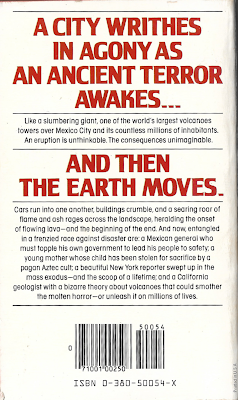
Popocatépetl stirs from his long slumber, sending deadly clouds of ash and stone across the land. The President dithers as pressure builds, paralyzed by careerism and superstition while General Mendoza contemplates the ultimate betrayal. Carmen Barbadillo seeks her children, kidnapped by El Cacique for an unspeakable sacrifice to placate the volcano. And Vargas kills, kills, kills in his vainglorious crusade, a catspaw for hidden forces working against General Mendoza, forces that may condemn 13 million people to eternity in a burning charnel house. Because if the American geologist Harry Carter is right, in six days Popocatépetl is going to explode, and nothing will survive THE FIRE CLOUD!
 |
| Iztaccíhuatl and Popocatépetl, with Mexico City in the foreground |
McKenney's novel is 310 pages, and not an ounce of fat. He never uses two words when one will do, and darns his threads with a delicate precision. Consider Felipe Vargas' ambush of three policemen on the beat, machine-gunned in their patrol car as a shock publicity statement for his terror gang El Partido del 10 de Junio. Another writer may have buried us in pages of character description for the doomed officers, sketching in their lives, loves, favorite ice cream flavors, all in an attempt to heighten the violent impact. But here, the attack is over in half a page and we know as much about the dead as Vargas does - nothing at all. The effect is actually more extreme, as we barely "see" these men in our minds eye before they are cut down. We don't even know their names. We never will, because Popocatépetl's initial violent outburst knocks everything else off the front page, happenstance that sends Vargas after bigger and bigger fish ... which suits his handlers' strategy of tension just fine thank you. The same restraint is held for El Cacique and his cultists, characters who would rapidly wear out their welcome in a lesser novel but appear here only when absolutely necessary and never veer into lame Satanic caricature. The doom laden atmosphere leaves no room for extraneous material, and the raw power of the land blends with General Mendoza's last ditch emergency plan that's a New World redux of Exodus - the roads are ruined, and all of Mexico City are to walk out of the danger zone - into something truly epic, beyond a banal genre label. Past and present, tradition and modernity, the soul and struggle of Mexico brought to the brink.
That American Harry Carter has a cutting edged theory about ignimbrite rocks, a product of pyroclastic flows, and about how to defuse a ignimbrite blast before it blows. General Mendoza is on board, but there's just one hitch. The sticking point is a capital-A bomb, to be thrown down Popocatépetl's throat and detonated like one goddamn big pressure release valve. Now we reach another point where so many novels stumble, the realm of high stakes geopolitics. Again, McKenney handles this with grace and a light touch, mixing fact and fiction with the Brazilian junta offering their secret weapon as calculated collateral to spur American aid. And oh, those Americans ... arrogant, ignorant, sympathetic in their way but forever foreigners in this land. Except, that is, for the outcasts, the adrift, like Carter with his crank ideas and the cynical NY Post journalist Mary Alice Jackson, sent down Mexico way to get some "sensational" copy but finding herself catatonic in the chaos until saved by Carmen Barbadillo's stolid peasant courage. One very pointed moment is past in a flash, when a crummy cowboy actor compliments General Mendoza on his English during hotline negotiations. But it's not McKenney's way to belabor a point. The final 20 pages move at a blistering pace into a cinematic climax worthy of the most state of the art SFX from ILM circa 1980, as a helicopter squad flies straight into Popocatépetl's hellmouth to deliver the payload.
The grasping ash, the burning pit, the pages practically char in your hands as the heat rises to a nuclear finish, with millions of bodies and souls at stake. For its passion, for its power, The Fire Cloud earns a full four pitiless pyroclastic flows out of four.
Avon Books, 1979