Showing posts with label hollow earth. Show all posts

Sunday, September 28, 2025

SPEARMEN OF ARN by Del Dowdell


Bumper Phillips was nothing special on Earth ... but true to planetary romance, on Arn he becomes an unstoppable killer! The most interesting thing about this work from Mormon apologist Del Dowdell is the hook whereby Bumper travels to the world of Arn: he's a last minute addition to the doomed Flight 19, and as they fly out over the Bermuda Triangle they encounter a horrifying portal to another world! 

Author Del Dowdell (1936-2022)

This is a neat enough trick by Dowdell, as one of the Avengers planes had an empty navigator seat, and since Bumper jumps in too late to be added to the flight list, he's never listed as missing alongside the rest of the crew. After flying through the portal, Bumper and the real life crew of Lieutenant Taylor and student pilots Powers, Stivers, Gerber and Bossi (and the rest!) are attacked by spearmen riding gigantic birds! Only Bumper survives, and thus begins his quest to run roughshod over this alien world, in the classic sword and planet tradition.

First though, he has to be trained in Arnian language and combat by the blind Tamarra, who lives in the deadly snake pits that Bumper is dumped in after his first, failed battle with the locals. Tamarra gives us some exposition too, about the dread Thelonese and their Sluices, the portals they use to rob water from other worlds. While the Thelonese work their dread machinations, the rest of Arn engage in petty struggles and backstabbing, and soon enough Bumper finds himself in the middle of some courtly intrigue among a society of cave people descended from other lost Earthers. Bumper, by the way, is prophecised as the Tyjen, a hero who will break the Thelonese of their hold on Arn, which causes him all kinds of problems.


Crave a smoke while questing? Why not a Newport?

Unfortunately, Dowdell has a tin ear when it comes to characters. Tamarra and Otar and Pelan are all decent enough sword and sorcery names, but what are we to make of Sram D'Crooz and Scarduun O'Grlea? D'Crooz and O'Grlea are two of the cave people, and I get that Dowdell was going for the garbled descendants of Earth names in their case, but it falls flat for me. Can't win 'em all, I guess ... but it doesn't help when the book is riddled with typos and these names are also being constantly mispelled!

In fact, if you thought that barbarian hero Kyrik had a tough time with editing flubs, wait 'til you meet Bumper Phillips! This poor guy ... not only are names misspelled left and right, continuity blows up in our faces more than once. Over at the Black Gate fantasy review site, Charles Gramlich says "at least one chapter appears to be completely missing between Chapters 12 and 13."


Tuurla? I never even knew her!

Consider the mysterious "Tuurla" who Bumper reminisces over along with all the other people he's met in Arn ... except he never got around to meeting her! Later, at the climax, Bumper rushes into the slave quarters to grab his friends Ryssta and Otar - except they were supposedly left behind with the Lady Arrmon several chapters ago, and Bumper was explicitly sent alone to the Thelonesian slavers! Ay yi yi!

Dowdell includes a few creepy critters, but compared to John Jakes' inspired descriptions in the Brak stories, they're pretty lackluster. We get the giant birds, the snakes in the pit, some kind of octopus thing, and a big cat that's like a tiger. A few more or more interesting creatures might have livened things up, ho-hum! Mostly Bumper just wanders around getting into trouble with the locals, until he finally winds up in Thelonesian custody and upsets their apple cart. By the time the heat is on, we're practically done with the story! Dowdell sets us up for an ongoing series, but nothing doing: Bumper is a one and done hero.

Dowdell also wrote another standalone planetary romance, Warlord of Ghandor, starring Robert of Eire:

This title is also reviewed by Charles Gramlich at the Black Gate link previously mentioned. And as also mentioned earlier, Dowdell specialized in Mormon history/apologia, like the Nephi Code series:

A love for the absolute accuracy of the Book of Mormon hasresulted in this four-volume series of books regarding the numerous misconceptions about where Lehi landed, where the Nephites' Land of Promise was located, and who really settled in Mesoamerica--including who the Jaredites of Noah's posterity were and how and when they came to settle in the Western Hemisphere. In a way no other work has done, this thoroughly researched and footnoted series of books discloses the descrptions [sic] and clues Nephi, Jacob, Mormon and Moroni left us throughout their writings and abridgements [sic].

For all the bugjacked errors and a less-than-ferocious pace, Bumper's adventures in Arn earn a rough 2/4 rating. There's some fun stuff here, like Arn's bizarre cosmology and the pan-galactic water thieving Thelonese, but not enough to overcome the lows. For those who wish to follow Bumper Phillips into oblivion, Spearmen of Arn is available to read and download at archive dot org. The nifty cover art is by Doug Beekman, by the by.

Belmont Tower Books, 1978

Monday, September 4, 2023

THE FLYING SAUCERERS by Arthur Shuttlewood


Arthur Shuttlewood: BESTSELLING AUTHOR OF 'THE WARMINSTER MYSTERY!' If that blurb meant anything at all to you in 1976, you'd be snapping this book right off the rack. The Warminster mystery concerned strange earth sounds heard in 1965 (said to knock birds right out of the sky!) which developed over the years into UFO sightings and photos of varying provenance. 

One photograph of the Thing ...

... and its location in the UK

Arthur Shuttlewood was a local journalist in the small town of Warminster who soon became entranced by the mysterious happenings of the Thing, as the mystery was eponymously dubbed. A series of books followed, and eventually Shuttlewood was fully enveloped in the '70s British UFO scene, dominated as it was by the muddled mysticism of the fascists behind The Flying Saucer Review. This current title is a melange of mystic mumbo jumbo that starts with a soft pedal as Shuttlewood goes over some regular British folk and their UFO sightings:


The bold cover art promises space aged revelations, with a pair of cutting edge F-104 Starfighters engaging a saucer. But soon enough Shuttlewood is delivering the standard mystic saucer stew, citing Brinsley le Poer Trench and Otto Binder for musings on ancient astronauts and their genetic plan for humanity, and quickly blending in hollow earth and polar openings with nary a hesitation. Shuttlewood name checks Kiwi pilot Bruce Cathie and his world energy grid alongside ley lines and supposed ancient Celtic nuclear piles, as he swerves into pyramid power and dense bouts of numerology. Says Shuttlewood:
My own belief is that the great pyramid is a multi-dimensional space-time condenser, the four-triad group of a veritable powerhouse in which every dimensional form of life in the whole universe could, if so deciding, converge and converse by pure mental communication.


There's a WWII sighting of an "egg shaped craft" by Polish fighter Antoni Szachnowski and mention of foo fighters, which sound like the typical nuts'n'bolts American stuff, and then suddenly Shuttlewood is dropping his favorite mystic numerology volume, The Seal of God by one F.C. Payne. Payne's work inspired Shuttlewood to investigate recent history for signs of divine guidance:
The six leaders whose nations were involved in the biggest show of hostilities in the history of mankind were: Churchill, Hitler, Roosevelt, Il Duce, Stalin, and Tojo. Take the initial letters of these names and what have we? Spell it out loud and clear, for it was and is so true! We have C-H-R-I-S-T!
Come page 83 Shuttlewood's quoting a crank letter he got from one Muriel Barker of Southend-on-Sea, which cites his colleague Brinsley le Poer Trench on the fact of Jesus Christ flying a UFO from Gethsemane to Glastonbury, where the Son of God inspires the legend of King Arthur! It's so British it hurts at times, especially with time capsule passages like: "Not many admirers know that vivacious Adrienne Posta, well-known actress and comedienne, saw a UFO on Monday 24 January 1972 at Cambridge Square, London." You're right, I didn't know that!

Ms. Posta looking glam

Shuttlewood's friend and former Warminster nurseryman Jack Harraway sends him translations of Spanish newspaper articles on UFOs, for an informative chapter which is also another time capsule piece, as Harraway is living in Alicante, Spain while serving on the executive committee for the National Farmers' Union in the Common Market. Further Britishisms follow as Shuttlewood quotes UFO witness Ray P. Logan, who hypothesizes that the flying sorcerers (as Shuttlewood's been calling them throughout) are avoiding direct contact with us in the same manner that we'd avoid waltzing right into the gorillas' enclosure at London Zoo, and that they're feeling us out through observation 
“very much as Dave Sexton, manager of Chelsea FC, will send scouts to watch another team’s style of soccer play before planning his tactics in a coming match.” Shuttlewood references John Keel and Robert Charroux for more ultraterrestrial meddling in ancient mysteries, before relating a strange experience with two college students named Micah and Joeb who demonstrated strange powers on a train - the weirdest part is that Shuttlewood separately receives an account by another experiencer, Marion, who met the same boys!

Shuttlewood relaxing with a cuppa ...

... and in the field (left), pointing out a
UFO location for the Marquis of Bath

The author's approach is summed up near the end, when he asks us, “Astrology, Numerology, Symbology: Have these abstract or long-forgotten arts any contribution to make towards slotting the UFO jigsaw pieces together?” The final chapter features some intense numerology, and at this point you're either vibing with Shuttlewood or you've written him off entirely.


Grand old UFO man Hilary Evans made his appraisement clear in his essential annotated UFO catalogue:


Right before his numerological rally, Shuttlewood drops a final anecdote about one Randy Otter's "zoo hypothesis" printed as an article in the Post Office Courier, which is reheated from Charles Fort's terse observation that "we are property." The Space Age calls out to the Golden Age with the musty archives of generations between, and Shuttlewood rallies round the maypole alongside Trench, Holiday, and the rest of the British mystic brigade.

The Flying Saucerers is available to read and download at archive dot org.

Sphere Books, 1976

Thursday, March 30, 2023

COSMIC DEBRIS: The Astrolo Watch and More Strangeness


From Strange magazine, a very cool looking watch! Just send $19.95 plus shipping and handling to some guys in Van Nuys! No sightings of this online nowadays, but there are plenty of other zodiac watch options out there.


And another sighting of the Cybertronic Destiny Wheel, now on offer alongside its mate the Cybertronic Detector and a half dozen other gewgaws. Take 'em all home for just $59.95!

Edit: check the comments for some more info on the Destiny Wheel, including patent information! Thanks, TK!


But just what was Strange magazine all about? It's an obvious Fate knockoff, and would you believe that those cheap manjacks at Popular Library have simply raided their copious backlog of Brad Steiger's Strange paperbacks to give us 31 more-or-less thrilling reprinted tales of the unknown? We also get a handful of tales copied over from Steiger's Strange Powers of E.S.P. from Belmont Books, such as the mini-skirt psychic, Rommel's ghost in the sand of El Alamein, and a seance attended by the Beatles. Other familiar Steiger standbys include Olaf Jansen's tales of the Smoky God of the inner earth bundled up with those damnable Deros, the man who records voices from outer space, and scads of ghost stories! Some of these are tales that Steiger did in fact source from Fate, with full credit given, making this even more of a ripoff volume. Some of the stories are better than others, but the good ones make up for the filler. His "Smoky God" chapter on Hollow Earth ideas - reprinted from New UFO Breakthrough from Award Books - is a standout, with more than enough goofiness to make up for some lame poltergeists and coincidences in other chapters. An interesting detail: some of the stories are credited to Steiger's birth name, Eugene Olson. Also worth noting that Strange had a far higher percentage of generic self help ads compared to Fate, which maintained a good rate of occult flavoring in its adverts.


Finally, here's an ad for another compilation mag - this one shares cover art with Steiger's The Occult in the Orient, which is pretty cool to be fair. 


As for what the hell this guy's doing, I have no idea ...

From Strange magazine, Volume 1 - Number 3, 1971. Courtesy Popular Library.

Thursday, February 23, 2023

TERROR ZONES by Adi-Kent Thomas Jeffrey


And it's terror time again as that titan of triangular tomes, Ms. Adi-Kent Thomas Jeffrey, takes us through a gripping global tour of TERROR ZONES! Right off the bat we have one of countless appearances in the paranormal literature by the apocryphal, untraceable death ship SS Ourang Medan, adrift in the Indian Ocean with a slaughtered crew, victim to some unknowable force from beyond. The Comte de Perouse disappears on a mission for France in 1789, and earlier still Dutch captain Bernard Fokke sails on a Sunday in 1650, cursing himself into history as the Flying Dutchman! In this opening chapter with the Indian Ocean, Adi-Kent outlines her thesis on the "terror zones," areas where the normal rules of time and space can suddenly be suspended. Ivan T. Sanderson's vile vortices get name dropped, and Jeffrey uses terror zones, triangle zones, and vile vortices interchangeably throughout the text, leading to some odd configurations:


How exactly are we supposed to orient our deadly triangles in the Indian Ocean? Never mind that, we're on to the next stop and a good one, the dreaded Sargasso Sea! Already we have the tone for Adi-Kent's text: lots of cheesy recreations with invented dialogue and events and less than rigorous historical sourcing. Dig cabin boy Elisha Thompson's wild ride into the Sargassum, as the sole survivor of the J.G. Norwood. The rest of the crew is washed overboard in a storm, and the ship becomes tangled in the legendary seaweeds of the Sargasso, whereupon Thompson deboards and explores several trapped derelicts including the SS City of Boston and the lost American warsloop Wasp.

E.S. Hodgson's lovely painting of the romantic Sargasso

Nowadays it's common knowledge that the classic romantic image of the Sargasso Sea as a graveyard of ghost ships is exaggeration, but that didn't stop writers like Jeffrey and many before her from spinning their tales, nor did it stop the mad lads at Hammer from making one of their most outlandish horror/sf films, the 1968 Sargasso shocker The Lost Continent, complete with an inbred society of Inquisition-era conquistadores who have been trapped in the weeds for generations, threatened by mutant monsters and the world-shattering arrival of a modern tramp steamer full of lost souls! In this feverish thriller we see how the paranormal is constantly reimagined and re-established with interplay between pulp fiction and "true" accounts.

All this and Dana Gillespie too!

This leads us into another of Jeffrey's stories, that classic triangle yarn on the Ellen Austin and the derelict, lifted wholesale from author William Hope Hodgson's short story "The Mystery of the Water-Logged Ship." Jeffrey gives us a very dramatic blow-by-blow recreation of events, in the best cheeseball style of Brad Steiger, all the more incredible for how completely fabricated it all is!

"The desert is the haunt of mystery. Sometimes men hear whispers of its past."

That's Adi-Kent quoting columnist Paul Wilhelm on the mystique of the desert, as she moves us away from the oceans and into the shifting sands. It seems that there's a legend of a lost ship stranded in the dunes of the American Southwest, and our author runs through some variations including Spanish galleons, a Chinese junk, a viking longboat, and a modern vessel that fell victim of the Salton Sea's shifting shoreline. Maybe the lost ship is full of gold and treasure, maybe it's cursed by its dead crew, maybe it's a will-o'-the-wisp luring the unwary to their doom ... who can say? Before we can dawdle too long, it's time for the next chapter on the Fata Morgana and a regional Hungarian variation called the délibáb, or déli báb as Jeffrey writes it. I guess mirages could be terror inducing, especially if you were lost in the desert or on the empty expanse of the Great Hungarian Plain ... but as the book goes forward, we can see that we're straying from the nominal focus of TERROR ZONES and into a general grab bag of worldwide weirdness. The people of the tiny St. Kilda archipelago, part of the Outer Hebrides off the coast of Scotland, are said to have ESP and to be generally strange or noteworthy. The Brown Mountain Lights of North Carolina are creepy enough, to be sure, but after that we move into a long chapter about long lived folk, including 142 year old Khaf Lasuria of Georgia, 170 year old (!) Shirali Muslimov (Jeffrey calls him Milimov) of Azerbaijan, 125 year old Miguel Carpio of Ecuador, and the Hunza people of Pakistan who all live for hundreds of years thanks to their special diet, which Adi-Kent notes briefly became a fad here in the West. Suffice to say none of these incredible ages are verifiable, but Jeffrey tries to work them into her model of TERROR ZONES nonetheless, theorizing on localized time dilations, human potentiality, and the like. It's pretty weak sauce, honestly.

Khaf Lasuria ... she don't look that old!

A fractured chapter follows on the Hollow Earth, with a slight but straightforward sketch of the idea and a quotation from John Symmes before Adi-Kent launches into the tale of three Norwegian boys who brave the maelstrom, with only Peter Arneson surviving as he latches onto a barrel and is catapulted out of the deadly whirlpool! Our author name checks Poe and The Narrative of Arthur Gordon Pym as well.

The terror manages to return with some rains of flesh and blood through the years, as well as an annual rain of sardines in Honduras, and a spectral sniper on the "missile mile" in the south of England who leaves bullet holes in car windscreens, without any attending bullets! Jeffrey calls these "supernormal assaults" and they're an apropos subject to finish up the book. Maybe this wasn't the most elegant volume from Adi-Kent Thomas Jeffrey, but it's hard to argue with how much strangeness she stuffs in, even with the disjointed results. She tries to tie a bow on everything at the very end with talk of parapsychology and the expanding frontiers of science, but nothing doing! It looks to me like our author wanted to keep her Triangle theme going from her prior works, but we know a classic Forteana potpourri when we see one, Adi-Kent!

Another edition made use of this incredible art from science fiction illustrator Peter Elson which plays up the Bermuda Triangle theme:


Panther Books, 1978 (original pub. 1975)


Sunday, February 13, 2022

THE UNDER-PEOPLE by Eric Norman


Still high on his NEW UFO BREAKTHROUGH from yesterday, Brad Steiger takes a spin under his pen name Eric Norman and delivers a rewrite of that same text, simply shifting the main focus from UFOs and Men in Black to the Hollow Earth and the startling discovery of THE UNDER-PEOPLE! It's (mostly) the same cast of kooky characters and twice-told tales, but Steiger tweaks the perspective just enough with some additional mythology. Material from this book would be heavily recycled by Steiger and Warren Smith for later Hollow Earth releases.

Who lives inside the Earth? Devils, angels, a master race? Cannibal lust demons? Steiger's just asking questions here, and there's room for reasonable debate! A revealing nitpick: Steiger cites the myth of Christopher Columbus disproving the Flat Earth as an example of the establishment brooking no dissent on the shape of the world. Of course, medieval people understood the Earth was round and weren't the ignorant dirt eaters the Columbus Myth would have us believe, but this citation of false historiography serves its purpose for Steiger's laundering of the fringe. A similar example is the common comparison of crank theorists to Galileo, persecuted by the Church. With that pedantic puffery out of the way, let's start digging into "one of the most provocative books of the year" and see if we can't unmask the Under-People!

Classic map by "Shavertron" artist Max Fyfield

Steiger must have had alchemy on the brain around this time, because that's where we lead off, before unearthing some OOP artifacts, mysterious roads and tombs, and celestial visions by trapped miners. There's also a weird black dwarf who gets drunk in a monastery wine cellar and is temporarily recruited as a monk, before being cast back into the darkness as a devil! Talk about a lost weekend. Shambhala and Agharta, Ultima Thule and Hadding Land, these and more mythologies figure into Steiger's decoding of the Under-People's identity. There's also the Zuni and other indigenous peoples' creation myths about an inner Earth origin. After a nasty overview of Pizarro's conquest of the Incas, with attendant myths of underground tunnels and secret treasures, Steiger cites his own New UFO Breakthrough and Harold T. Wilkins on ancient underwater ruins and nuclear bomb shelters.

One "Maggie Rogers" has her manuscript about contact with the Under-People summarized in a chapter. Originally published by Ray Palmer in Amazing Stories alongside the ongoing Shaver saga, it's a similar story, with "Tamil and Nephli" underlords and a druggy, sexed out atmosphere. That phony story of the good ship Jesmond landing on Mid-Atlantic ruins introduces us to a section on Atlantis, and Steiger casts quite a wide net here, dredging up ol' Madame Blavatsky and Edgar Cayce among others. Next we hear from Gray Barker and his Saucerian Bulletin, setting us up for a dark section on Hitler and the Hollow Earth which would also be reused by Steiger and Smith in future. More recycling occurs with Olaf Jansen and the Smoky God - this chapter would be repeated verbatim by both Smith and Steiger in many later books.

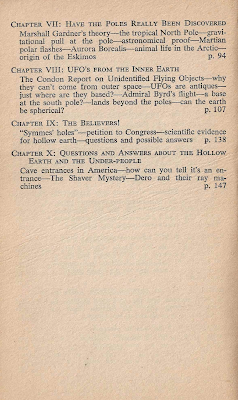
We're nearing the end of the saga, checking in now with modern proponents of Hollow Earth such as Marshall B. Gardner who asks "Have the poles really been discovered?" His full text from 1913, A Journey to the Earth's Interior, is available for reading at the Sacred Texts website. His book seems to be the source for the story of the "mysterious origin of the Eskimo" which, again, wound up in many of Smith and Steiger's other books. Finally now Steiger rolls in the big guns and gives us Richard Shaver and Ray Palmer, the two men who most popularized modern Hollow Earth with their eminently readable paranoid pulp fiction. Steiger quotes heavily from an article by Palmer on Hollow Earth and UFOs, which seems to quote without citation from Dr. Raymond Bernard's book The Hollow Earth  on Admiral Byrd's expedition "beyond" the pole. Perhaps this is an error by Steiger or Award Books and Palmer cited Bernard in his original article. A quick sketch of early Hollow Earther John Symmes and a detour to mysterious Mt. Shasta are inserted before we make one final push into that blockbuster Shaver Mystery! By the way, the first five stories of the Shaver Mystery are available to read and download at archive dot org, so you can see for yourself Shaver's strangely compelling psychosexual Pellucidarian saga.

Shaver and Palmer together

After all this melodrama, Steiger ends abruptly by asking us "What do you believe?" This would become Warren Smith's go-to ending for his Zebra specials from the mid-70s, but it's a limp copout line if you ask me: "I dunno, here's some wild stuff. Crazy, huh?" Stick to your guns, Steiger! Or at least steal a better ending!


Award Books, 1969