Showing posts with label panther books. Show all posts

Tuesday, February 27, 2024

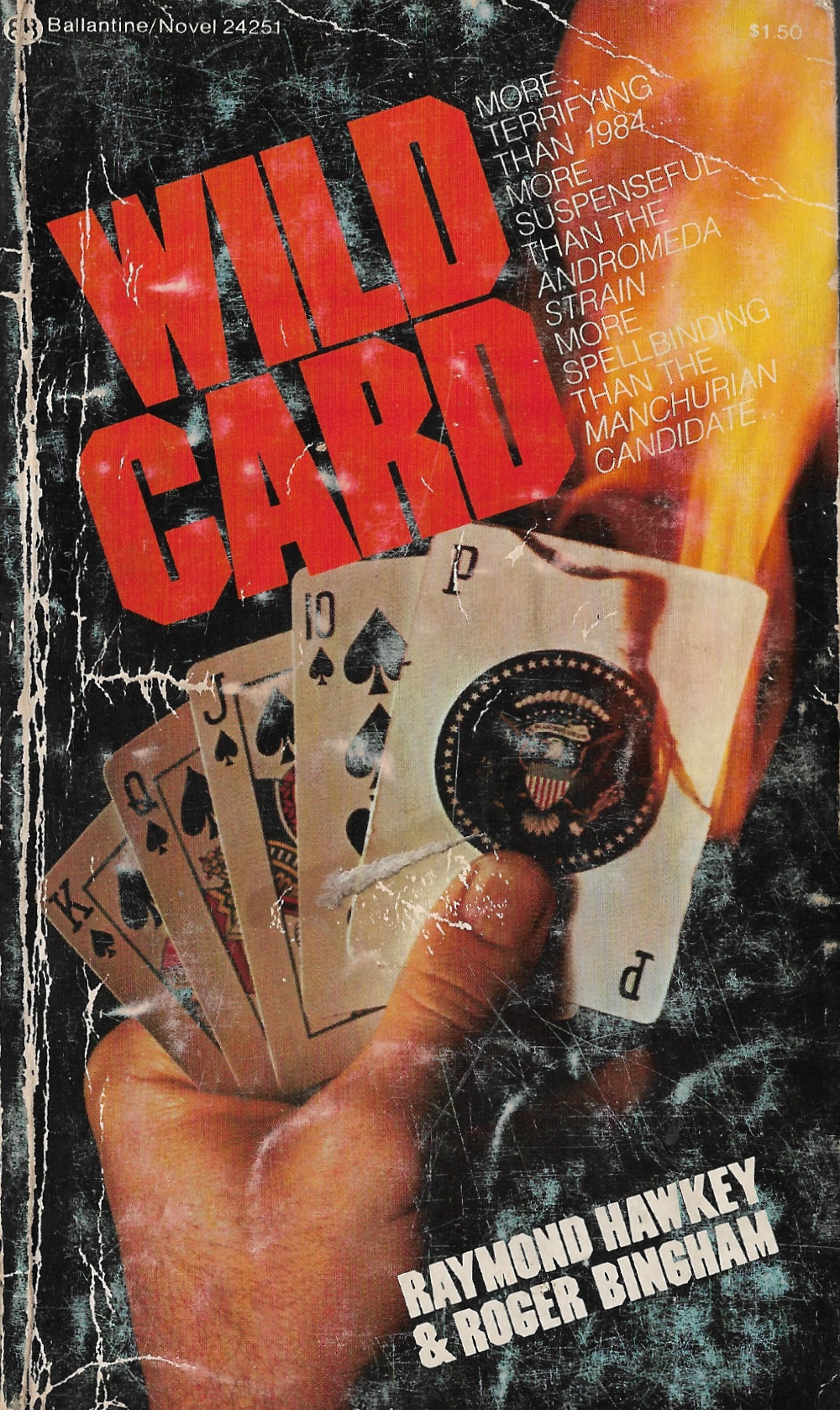
WILD CARD by Raymond Hawkey and Roger Bingham


Here's a weird one: a parapolitics thriller starring an unnamed President, set in a delightfully gonzo 197X near future setting where urban guerrillas have gotten ahold of suitcase nukes and the traffic is still hell on earth! The Fortress of America is coming apart at the seams, so science adviser Nadelman proposes some necessary evil: a faked UFO invasion, complete with an alien infection! Only such an otherworldly threat could possibly save these disunited states. The President isn't quite sold, but one assassination attempt later he begrudgingly signs off, and Wild Card lets loose.

Once we're off, however, the story proves muddled and unfocused. I'm glad the authors avoided two fisted filler and potboiler beats, but most of the way through it feels like we're reading a short story that just happens to keep going. There's nothing wrong with their writing per se, but things never quite come together, and threads fail to develop fully before we move onto the next sequence. And for all the acknowledgments front and back dedicated to real life scientists about the techniques described within, not much of it seems to come out in the final product, save for a deadly reveal one of the characters overhears, and a sci-fi device that comes in at the end to put a little twist on things. The alien building is fun though, as the scientists in the story play around with science fiction tropes and attempt to create realistic fictional invaders.

To Hawkey and Bingham's credit, there is a crackerjack disaster sequence near the end, and the usual downbeat '70s ending with a little cynical twist. Those creative scientists are finely drawn, a midcentury mix of careerists, ex-Nazis, and idealistic babes in the woods, none of whom can fully understand the tenuous nature of their continued employment - or survival! The authors also handle the President and his cabinet well, leaving him nameless and letting the setting speak for itself as to political developments in the near future. There's a lovely sequence near the beginning where the President watches a news broadcast and pays special attention to the graphic design on the little screen behind the anchor - he sees the Statue of Liberty and the US dollar getting destroyed, graphically on screen just as they are not-so-metaphorically outside in the real world. Hawkey was a graphic designer in another life and can be credited with the modern look of the airport thriller!

From the MI6 HQ website

Wild Card's cover art from Ballantine Books is uninspired but gets the job done, and at least it's not as hackneyed as this Panther edition from 1976:

Ahhh, a skeleton!

Hawkey wrote two more thrillers in the same vein sans Bingham, and they make up the loose Presidential Trilogy:


Everything in this goofy ride is eminently plausible, from false flag UFOs (some may also remember Reagan's fixation on alien invaders as a conduit to world peace) to domestic biowarfare (more ably presented in other thrillers like The Nightmare Factor and The Black Death, and partially archived among other places under the Special Virus Cancer Program). It's just a shame that it doesn't congeal into a successful story. Wild Card tries to go all in but busts out with a mediocre 2/4 rating.

Ballantine Books, 1974

Thursday, February 23, 2023

TERROR ZONES by Adi-Kent Thomas Jeffrey


And it's terror time again as that titan of triangular tomes, Ms. Adi-Kent Thomas Jeffrey, takes us through a gripping global tour of TERROR ZONES! Right off the bat we have one of countless appearances in the paranormal literature by the apocryphal, untraceable death ship SS Ourang Medan, adrift in the Indian Ocean with a slaughtered crew, victim to some unknowable force from beyond. The Comte de Perouse disappears on a mission for France in 1789, and earlier still Dutch captain Bernard Fokke sails on a Sunday in 1650, cursing himself into history as the Flying Dutchman! In this opening chapter with the Indian Ocean, Adi-Kent outlines her thesis on the "terror zones," areas where the normal rules of time and space can suddenly be suspended. Ivan T. Sanderson's vile vortices get name dropped, and Jeffrey uses terror zones, triangle zones, and vile vortices interchangeably throughout the text, leading to some odd configurations:


How exactly are we supposed to orient our deadly triangles in the Indian Ocean? Never mind that, we're on to the next stop and a good one, the dreaded Sargasso Sea! Already we have the tone for Adi-Kent's text: lots of cheesy recreations with invented dialogue and events and less than rigorous historical sourcing. Dig cabin boy Elisha Thompson's wild ride into the Sargassum, as the sole survivor of the J.G. Norwood. The rest of the crew is washed overboard in a storm, and the ship becomes tangled in the legendary seaweeds of the Sargasso, whereupon Thompson deboards and explores several trapped derelicts including the SS City of Boston and the lost American warsloop Wasp.

E.S. Hodgson's lovely painting of the romantic Sargasso

Nowadays it's common knowledge that the classic romantic image of the Sargasso Sea as a graveyard of ghost ships is exaggeration, but that didn't stop writers like Jeffrey and many before her from spinning their tales, nor did it stop the mad lads at Hammer from making one of their most outlandish horror/sf films, the 1968 Sargasso shocker The Lost Continent, complete with an inbred society of Inquisition-era conquistadores who have been trapped in the weeds for generations, threatened by mutant monsters and the world-shattering arrival of a modern tramp steamer full of lost souls! In this feverish thriller we see how the paranormal is constantly reimagined and re-established with interplay between pulp fiction and "true" accounts.

All this and Dana Gillespie too!

This leads us into another of Jeffrey's stories, that classic triangle yarn on the Ellen Austin and the derelict, lifted wholesale from author William Hope Hodgson's short story "The Mystery of the Water-Logged Ship." Jeffrey gives us a very dramatic blow-by-blow recreation of events, in the best cheeseball style of Brad Steiger, all the more incredible for how completely fabricated it all is!

"The desert is the haunt of mystery. Sometimes men hear whispers of its past."

That's Adi-Kent quoting columnist Paul Wilhelm on the mystique of the desert, as she moves us away from the oceans and into the shifting sands. It seems that there's a legend of a lost ship stranded in the dunes of the American Southwest, and our author runs through some variations including Spanish galleons, a Chinese junk, a viking longboat, and a modern vessel that fell victim of the Salton Sea's shifting shoreline. Maybe the lost ship is full of gold and treasure, maybe it's cursed by its dead crew, maybe it's a will-o'-the-wisp luring the unwary to their doom ... who can say? Before we can dawdle too long, it's time for the next chapter on the Fata Morgana and a regional Hungarian variation called the délibáb, or déli báb as Jeffrey writes it. I guess mirages could be terror inducing, especially if you were lost in the desert or on the empty expanse of the Great Hungarian Plain ... but as the book goes forward, we can see that we're straying from the nominal focus of TERROR ZONES and into a general grab bag of worldwide weirdness. The people of the tiny St. Kilda archipelago, part of the Outer Hebrides off the coast of Scotland, are said to have ESP and to be generally strange or noteworthy. The Brown Mountain Lights of North Carolina are creepy enough, to be sure, but after that we move into a long chapter about long lived folk, including 142 year old Khaf Lasuria of Georgia, 170 year old (!) Shirali Muslimov (Jeffrey calls him Milimov) of Azerbaijan, 125 year old Miguel Carpio of Ecuador, and the Hunza people of Pakistan who all live for hundreds of years thanks to their special diet, which Adi-Kent notes briefly became a fad here in the West. Suffice to say none of these incredible ages are verifiable, but Jeffrey tries to work them into her model of TERROR ZONES nonetheless, theorizing on localized time dilations, human potentiality, and the like. It's pretty weak sauce, honestly.

Khaf Lasuria ... she don't look that old!

A fractured chapter follows on the Hollow Earth, with a slight but straightforward sketch of the idea and a quotation from John Symmes before Adi-Kent launches into the tale of three Norwegian boys who brave the maelstrom, with only Peter Arneson surviving as he latches onto a barrel and is catapulted out of the deadly whirlpool! Our author name checks Poe and The Narrative of Arthur Gordon Pym as well.

The terror manages to return with some rains of flesh and blood through the years, as well as an annual rain of sardines in Honduras, and a spectral sniper on the "missile mile" in the south of England who leaves bullet holes in car windscreens, without any attending bullets! Jeffrey calls these "supernormal assaults" and they're an apropos subject to finish up the book. Maybe this wasn't the most elegant volume from Adi-Kent Thomas Jeffrey, but it's hard to argue with how much strangeness she stuffs in, even with the disjointed results. She tries to tie a bow on everything at the very end with talk of parapsychology and the expanding frontiers of science, but nothing doing! It looks to me like our author wanted to keep her Triangle theme going from her prior works, but we know a classic Forteana potpourri when we see one, Adi-Kent!

Another edition made use of this incredible art from science fiction illustrator Peter Elson which plays up the Bermuda Triangle theme:


Panther Books, 1978 (original pub. 1975)


Friday, January 21, 2022

THE HERMES FALL by John Baxter


Who will survive and what will be left of them when author John Baxter slams asteroid Hermes into the North Atlantic at 150,000 miles per hour? It's a classic '70s disaster epic with all the sex, sleaze, and world ending cataclysm you'd hope for, plus some biting criticism of NASA politics with the freshly debuted space shuttle facing a trial by fire in its new mission to destroy Hermes. No prizes for guessing how that goes ...

Baxter says he was inspired to write the novel following his research on the Tunguska event for his nonfiction work The Fire Came By. Here he rises to poetry with his passages on the asteroid, while the plotting and characters are crafted finely enough to avoid the fill-in-the-blank formula tang of many disaster/thriller novels. The novel only falters in the final 50 pages, when our hero astronaut must suddenly race cross country to save his girlfriend from some escaped convicts. It's clear Baxter was attempting to draw down the perspective and end on a human level, but the contrived circumstances and attendant rape peril are a shoddy comedown from the previous highs.


The Hermes Fall was one of a trio of big space rock novels released in quick succession at the end of the '70s. Lucifer's Hammer came out in 1977, followed by The Hermes Fall in 1978 and Shiva Descending in 1980. Hermes is the best of the three. Niven and Pournelle's Lucifer's Hammer is techno-fascist wish fulfillment for the soft suburban set, with the end of the world allowing the authors to justify their reactionary worldview putting minorities, women, and dirty hippies firmly in their place. Benford and Rotsler's Shiva Descending suffers from turgid plotting and card stock characters. Worst of all is the simple fact that neither book captures the chaotic, all consuming destruction of the fall nearly as well as Baxter does, though Niven and Pournelle get credit I suppose for being the first out of the gate.


Across the pond, Panther Books released this tatty looking edition.

And its teeth are bared in a terrible hatred ...

4/4

Ballantine Books, 1978

Tuesday, March 3, 2020

THERE ARE GIANTS IN THE EARTH by Michael Grumley


General overview of the usual suspects, with the inclusion of hairy hominid also-ran Ameranthropoides loysi, or De Loys' Ape - a creepy critter with an unsavory background in racial pseudoscience. Features some charming illustrations by the author.

Available to read and download at archive dot org.

Panther Books, 1974