Showing posts with label 1982. Show all posts

Wednesday, July 31, 2024

MAPS OF THE UNKNOWN: Loch Ness V


A useful map of sightings and vantage points from the 4th edition of Loch Ness Monster by Tim Dinsdale.

Courtesy Routledge & Kegan Paul Ltd, 1982 (original pub. 1961).

Sunday, March 17, 2024

BIGFOOT: AMERICA'S NUMBER ONE MONSTER by Daniel Cohen


Watch out! This is a Bigfoot primer for younger readers by reliable pop-sci writer Daniel Cohen which rivals "adult" titles for its measured style and broad coverage of AMERICA'S NUMBER ONE MONSTER. All the usual Bigfoot history is here, with Ape Canyon, Albert Ostman, the Patterson-Gimlin Film, Momo, the Minnesota Iceman, and so on. Cohen even mentions William Roe's sighting and includes artist Morton Kunstler's recreated drawing of the event, but leaves out any description of big Bigfoot breasts, perhaps in deference to his young audience. The Roe/PGF connection would have to wait a few more years to be made explicit ...


There's lots of maps and illustrations, including several of Momo and two different cartoons where the gag is that Bigfoot's a tiny little guy with giant feet.


Cohen does a bang up job relating recent Bigfoot sightings, including many involving UFOs and other high strangeness. The most disturbing of these concerns one Stephen Pulaski of Uniontown, PA, who witnesses some hairy beings next to a parked UFO in a field. He tries shooting them, but nothing doing, and they leave. Later, he suffers apocalyptic nightmares!


The only letdown is Chapter 10, Bigfoot History, where Cohen's normally meticulous style slips and he throws in a handful of Native American "Bigfoot" stories that really seem nothing like it  - he calls the dread Wendigo a "huge creature of terrifying strength" and says it eats human flesh, but leaves out the demonic qualities and function of the cannibalism taboo entirely! One wonders how the other monsters like the Mahoni of the Yukon (not given a source), the Enemy (described by the Tlicho or Dogrib people), and the Gugwes (described by the Micmac) are being misrepresented. Cohen does accurately describe the original Sasquatch people related by J.W. Burns as being "wild Indians" as opposed to apemen.

Cohen tracks Bigfoot all over the country, and worldwide too, including those wonderful Almas who don't seem to get much press nowadays. It's an honest survey of a varied subject that normally gets a ... let's say selective presentation in many other sources. One odd detail sticks out though, when Cohen says that no one knows how the term "Abominable Snowman" came about. Real Bigfoot heads will know the popular story of newsman Henry Newman's coinage of the term, as related by Ivan T. Sanderson and others in Bigfoot literature. Was Cohen ignorant of the story or did he just not believe it?


Cohen doesn't discriminate in whether a Bigfoot sighting is proper or not, and as mentioned the freaky Hairy Bipeds of the '70s Midwest UFO waves get ample inclusion, including credit to Jerome Clark and Loren Coleman's Creatures of the Outer Edge (1978). His final chapter goes over competing theories for the monster, from simple apeman to surviving proto-human to space visitor to inter-dimensional ultraterrestrial to all out hoax. This volume would have been a good introduction to the subject for young readers back in 1982, and despite some nitpicking by your reviewer still holds interest today as a very professional presentation of a well trod subject.

Bigfoot: America's Number One Monster is available to read and download at archive dot org.

An Archway Paperback Original, 1982

Thursday, August 31, 2023

EXTRATERRESTRIAL by Julian Shock


Successful author Spencer Torrence has arrived with his family at the Hotel Holroyd for a mysterious writer's convention. His friend the "science expert" Dan Lloyd is there, along with some real life big names, but nobody seems to know who's running things, and people start experiencing hackneyed horror scrapes from the very start - Spencer's daughter Lauren sees her doppelgänger behind a curtain, Spencer himself notices that the furniture's been moved all around the lobby, and everyone is on edge with an impending feeling of doom. They're right to be afraid, because the convention is actually a trap laid by EXTRATERRESTRIAL visitors who have some unearthly, unthinkable plans for their guests!

Our aliens? A male and female pilot, and their offspring. Humanoid, just like you and me really. But the fourth member of the crew? A hideous being, a biological computer called the Selector, which suffers a parody of life submerged in a chemical bathtub and grants its crewmates glimpses of future probabilities through its psychic powers. Scanners may live in vain, but the Selector lives for pain, inflicting the purest nerve shredding agony on any being unlucky enough to touch minds with it - turns out, telepathy is an exquisitely awful experience. The female pilot suffers greater indignity still as the Selector mentally manipulates her "erotic centers," forcing her to enjoy their interactions and "filling her with a transient urge to mate." This grotesquerie is a highlight of the story, and too bad we've peaked on page 12 ... it's all downhill from there.

Author "Julian Shock" was actually a pseudonym for one J.N. Williamson (1932-2005), a prolific writer, editor, and old horror hand who also acted as a mentor for authors starting out in the field. Those who knew him have nothing but kind words, while readers of his books have more mixed opinions. Extraterrestrial suffers from slack writing, slapdash storytelling, and the overriding feeling that Williamson just didn't care that much! The tone throughout is of shrill cynicism, with occasional, awkward stabs of cornball cuteness thanks to young daughter Lauren and her adorable kitten named Puck. Williamson loads his story up with literary references like J.D. Salinger and portentous quotations from the likes of Carl Sagan, Alvin Toffler, and the Epic of Gilgamesh - I'm usually a sucker for that sort of thing, but none of the text that follows really seems to engage with the heavy framing. The aliens (minus the Selector) are straight out of '50s comic books, 100% human except for their high technology and their alien cuss words: francle striv! The male pilot is a real dickhead, and a dullard besides as he makes the same old ET observations about how much we look like ants from up here and how pathetic and dumb we are, blah blah blah! The female pilot gets some deeper characterization as she's fully engaged with the (im)moral questions of their mission, and maybe if their plan wasn't so goofy it'd make for some righteous sturm und drang ... but again, it all seems like something out of a '50s comic book, with the aliens setting up a writer's convention to brainwash/replace these influential members of society, terrorizing them with cliched horror jump scares in the process ... and how silly does that sound nowadays in 2023, by the way, targeting novelists for a culture war campaign? Williamson is extremely self-indulgent throughout, playing lots of games with his doppelgänger theme and having fun with UFOlogy and hoary old sci-fi tropes, but it's all for naught on the reader's end. I'm sure there's also lots of clever references to writer friends and inside jokes about the industry peppered through the text.

The author ...

... and some of his work

Zebra Books did a nice job packaging this dud, at least. The front and backpage ads let you know the audience they were trying to entice - he-man readers of The Survivalist series and spy novels where "video joy games" become deadly SPY GAMES, plus desperate horror junkies willing to try another Williamson joint, Death-Coach (this one released under his own name).

Despite the slick presentation, Extraterrestrial earns a limp 1/4 rating for brief flashes of cosmic angst amidst a pedestrian horror tale.

Zebra Books, 1982

Monday, June 27, 2022

GENESIS by W.A. Harbinson


Author W.A. Harbinson delivers us this "true story" treatment of the flying saucer phenomena, starting with the mystery airships of the 1890s, on through foo fighters and saucer crashes, cattle mutilations and saucer cults, culminating with wunderwaffe and secret Antarctic bases revealing the terrible secret of GENESIS!

It's all very clever and meticulous but eventually collapses under its own weight, as every bit of UFO trivia must be incorporated into the increasingly top heavy narrative. What's left is less of a story and more a bullet list, and once we grasp the structure the whole enterprise is rendered plodding and turgid. Major spoilers follow, so be warned!

Our antagonist, it turns out, is a mad scientist from the 19th century, the inventor of those mysterious airships. As the years rolled on, he perfected his flying machines, ultimately making the sociopathic choice to work for Hitler's reich to reach even greater heights. His flying saucer wunderwaffe predate the now common modern formulation of Die Glocke, but as we know Nazi UFOs were nothing new in the subculture. 

From money making schemes by
run-of-the-mill neo-nazis ... 

... to poorly thought out products by model makers!

Following the fall of Berlin, our mad scientist flees to New Swabia and sets himself up with some robotized Nazi slaves and a fleet of flying saucers. Complicating things, the US government is also engineering their own crude saucers, which is a nice touch that adds some depth - no wonder UFO reports are so varied and strange, if multiple culprits are to blame. By the by, our villain has also unlocked anti-aging treatments, and a good thing too because he's coming up on 120 now! The early atmosphere of paranoia that Harbinson stokes degrades into nihilistic boredom - what horrific evil will our villain unveil next? Ho hum.


We are no monsters, we're moral people
And yet we have the strength to do this
This is the splendor of our achievement
Call in the air strike with a poison kiss

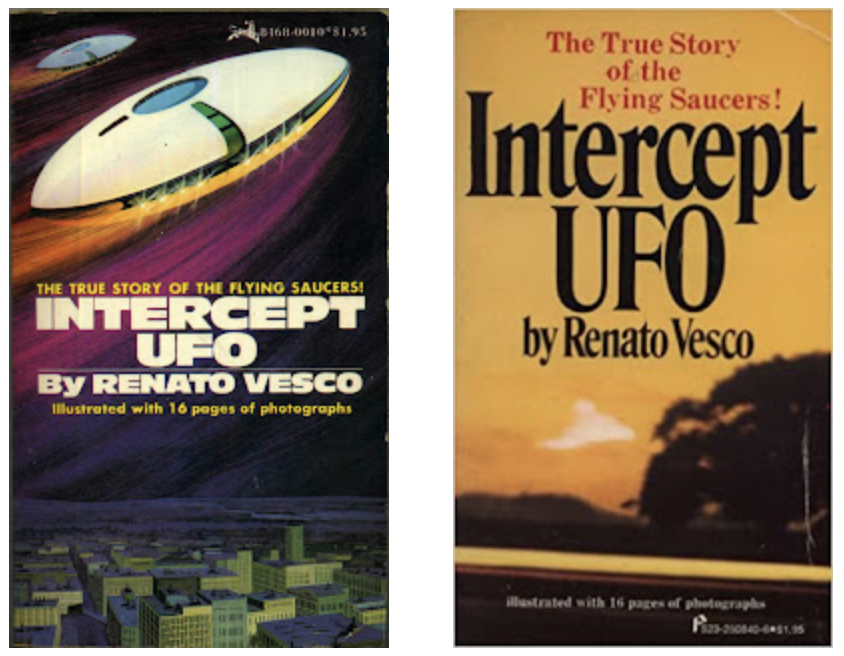
Harbinson includes an author's note and source appendix after the story, drawing heavily on the unreliable Renato Vesco, Italian ex-NASA contractor who assembled a UFOlogical history in his Intercept UFO which parallels many of the tacks taken in Genesis. Harbinson admits that much of Vesco's narrative is unsupported but no matter, it makes a good tale. He recommends a swath of UFO titles as well as WWII texts and some psi titles. Ol' Brad Steiger sneaks in with his edition of Project Blue Book - one of his stronger titles due to simply being the released Blue Book papers. His inclusion shows how the high and low mix in UFOlogy, purported hard facts mixing with innuendo and fantasy.


Over the years Harbinson has expanded his Genesis into a series, titled Projekt Saucer. For an ambitious misfire, Genesis earns one wunderwaffe out of four:


Dell Publishing, 1982 (original pub. 1980)

Thursday, February 24, 2022

THE WAVE by Christopher Hyde


What's worse than a tsunami? Try a nuclear tsunami! Actually, despite the fantastically flash cover art, THE WAVE isn't a tsunami at all, but a gigantic dam break wave surging down the Columbia River. And what's in its path but the aging Hanford Nuclear Waste site, which in this story is home to a brand spanking new breeder reactor - purely a fictional construct, thank goodness. The failure point is the Mica Dam in British Columbia, "one of the largest earthfill dams in the world" ... and different characters in this story fill us in on all the dangers this kind of dam construction entails, and all the corrupt/incompetent politicking that went on to get the Columbia River Treaty passed way back in 1961, which outlined Canada and the USA's hydroelectric responsibilities on said river. Author Christopher Hyde present a sadly all-too plausible disaster scenario in the best '70s thriller style, in line with the early work of Michael Chrichton. As the cover blurb says, THE WAVE isn't just fiction, it's tomorrow headlines!

Hyde does his best work around the circumstances of the creeping disaster, both physical and political. We get a crash course on the Vajont Dam disaster of 1963, which claimed over 2,000 souls in Italy, and the aforementioned outline on the political scene leading to the Mica Dam's construction. Meanwhile, simple passages on a single pebble rolling down hill or ripples lapping at the dam become sublime, loaded with the quiet threat of what we know to come. Hyde does less well with the requisite '70s thriller conspiracy elements, with clumsy references to the conspirators' membership in Skull and Bones, and the need to find "an Oswald" as a patsy to take care of our nosy protagonists. He still manages a paranoid atmosphere, but some of the skulduggery feels like filler on the way to the main event. And woo boy, once that water starts rolling ...


On our side of the pond, Playboy Paperbacks put out this attractive edition in 1981.

Spoilers (of a sort): the radioactive wave doesn't make it to the ocean, sparing us a precursor to the Fukushima nuclear disaster of 2011. But there's plenty of delicious destruction along the way, with floods and firestorms and a nuclear hostage situation. Half the fun of any random disaster thriller is learning about a brand new subject and all the horrible ways it can go wrong. A good thriller author takes us under their wing for a time, selling us on these awful visions. Hyde acquits himself well in that respect, even with some narrative speed bumps. A fake transcript of congressional hearings after the disaster is a penultimate dollop of verisimilitude, followed by a stinger of the conspiracy taking out its own trash, another realistic touch.

3/4

Coronet Books, 1982 (original pub. 1979)

Sunday, September 12, 2021

MONSTER by Jeffrey Konvitz


Boring! This is one turgid, overlong excuse for a "thriller" ... Jeffrey Konvitz was clearly banking on another big budget adaptation like his breakout hit The Sentinel, but this by-the-numbers potboiler didn't catch anyone's eye in Hollywood, and for good reason. From the convoluted setup (oil is discovered beneath Loch Ness, and exploration by the Gemini Company disturbs Nessie) to the following lack of monster action (she gets two "big" scenes that are over far too quickly) this novel just fails to deliver. It doesn't help that it seems like Konvitz tossed his monster research off in an afternoon and fills most of the book with his two-fisted hero's battle against a nasty piece of mercenary trash named Lefebre (that's lah-FAYVE by the way), the security head for Gemini Oil. 

Oh well, at least there's a nice step-back and map.

0/4

Ballantine Books, 1982