Showing posts with label space rock. Show all posts

Thursday, November 28, 2024

IMPACT! by R.V. Fodor and G.J. Taylor


Brace for IMPACT! Geologist R.V. Fodor joins with G.J. Taylor (having also coauthored Junior Bodybuilding) for this hefty addition to the big space rock genre of the late '70s. What are we in for when a swarm of meteoroids crosses our path?


Fodor and Taylor have written an odd duck here, with too many dropped threads and dead ends. They give us just a taste of the usual big disaster tropes, with President Stein and his men debating doomsday, scientists decoding the composition of the rocks, and us little people facing oblivion, but soon enough we realize that we're halfway through a 400 page would-be epic and nothing much has happened!

Stein's science advisor is a Malthusian creep with a roster of self serving double talk as to why we should let the big one smash into Central Asia, knocking out the USSR and China and launching a new ice age that will kill billions worldwide. There's some unsatisfactory '70s style cloak and dagger action over exposing this evil plan, but like everything in the story it reads as a pale shadow of other, better writing. There's not much from the POV of the rocks either, which is usually my favorite part of space rock disaster thrillers. 

Again and again, Fodor and Taylor drag us through pages and pages of establishing characters only to drop them for the next batch, without building on anything they're already written. The highlights are front loaded, with the complete destruction of small town Ardmore, KS due to a single relatively "small" meteor, and a charming detail about how the satellite surveillance nerds of the Intermilitary Data Center enjoy watching volcanic eruptions change the landscape. Unfortunately nothing really gels as the story unfolds, and the last 100 pages read like filler. By the time the apocalypse smashes down we don't really care, which is never a good sign when you've got the fate of the world in the balance.

The Sino-Soviet split makes for some attempted suspense, with those goddamn Chicoms playing the long game - what's a few hundred million deaths to those inscrutable Orientals anyways?


We get some perfunctory space action in the home stretch, and a ridiculously convenient reveal that saves our boring lead couple from vaporization. Yawn!


Fodor and Taylor's disaster slog earns a very sad 1/4 rating ... It's not as outright crap as Mayhew and Long's Fireball, but there just isn't enough to recommend here. Getcher space rocks off elsewhere.


Lesiure Books, 1979

Friday, January 19, 2024

FIREBALL by Vic Mayhew and Doug Long.


"The jeans and heavy white sweater she wore warned Young that she was in a practical, no-nonsense mood."

It took two authors to write that tripe. As far as disaster novels go Fireball is a stale dud, a truly forgettable entry in the big space rock boom of the late '70s. Even the title fails to excite, lacking the cold technothriller edge of something like Meteorite Track 291 or the poetry of The Hermes Fall or Lucifer's Hammer. It really feels like we got the leftovers here, with Mayhew and Long gifting us paper thin characters and dragging us through some stilted Cold War skulduggery between the Americans and the Soviets, neither of whom want to admit they've developed space nukes which could save the day at the cost of face. Hero NASA administrator Matt Young doesn't trust the Russkies, of course, and wouldn't you know it they've gone and filmed his colleague Bob Bigelow's runaway daughter turning tricks in an NYC hotel! The Russians also give one of their own the old poison umbrella, which feels like something Mayhew and Long inserted as a Hail Mary pass at gritty spy craft.

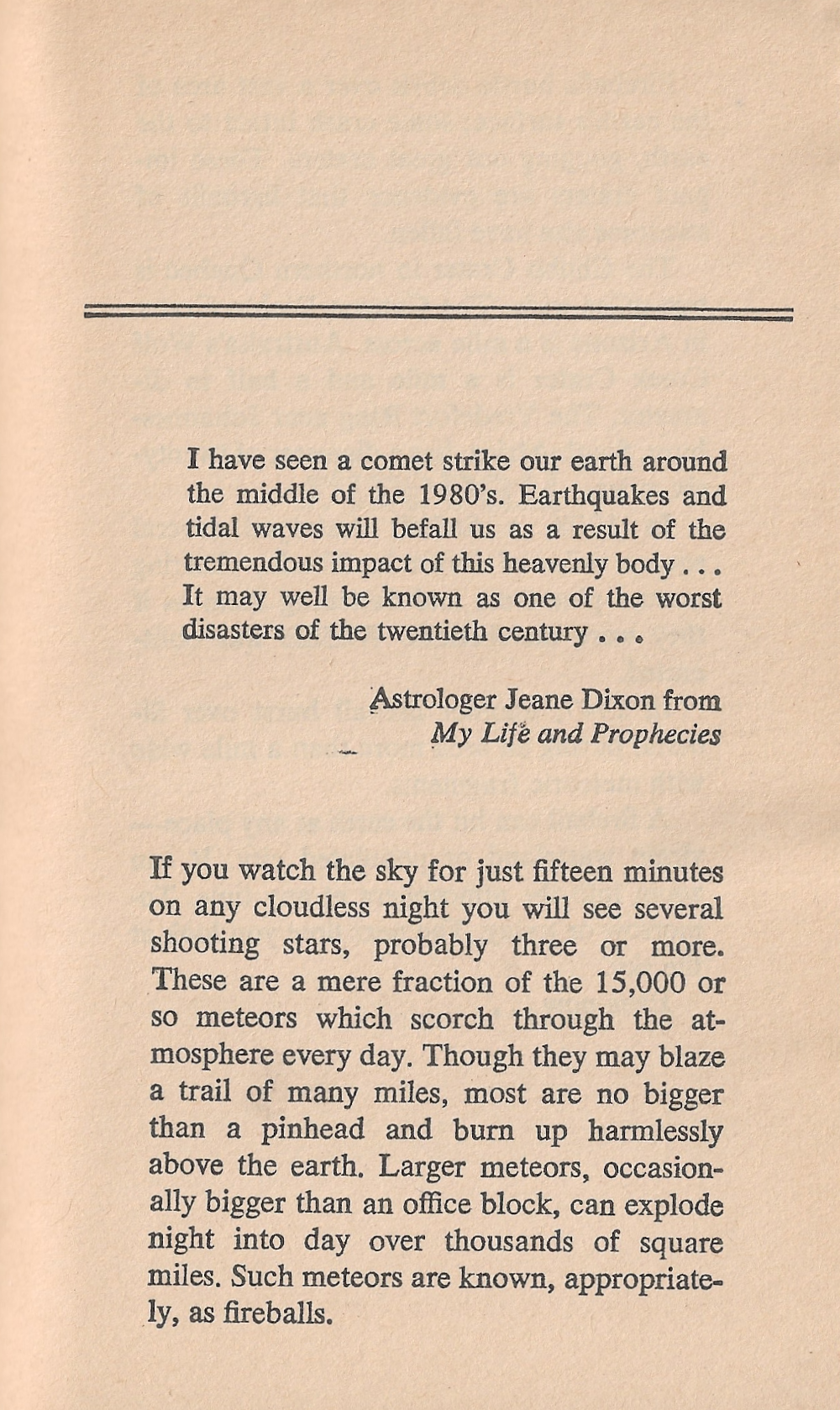
This ho-hum thriller filler takes up too much of the novel, as does Bigelow's family drama - his young son discovered the fireball in his backyard observatory, but Bigelow's too much of a bad dad to give the kid his due. Mayhew and Long seem incapable of writing genuine dialogue between their characters, with Matt Young and his reporter girlfriend Jenny exchanging underbaked bon mots and everyone else shouting, barking, growling the standard disaster fluff at each other. The scenes checking in on the asteroid's progress through deep space are dull as well, with none of the flair or menace other writers brought to their asteroid novels. John Baxter's single line in The Hermes Fall: "And its teeth are bared in a terrible hatred," is more effective than anything Mayhew and Long can produce. Their invocation of celebrity psychic fraud Jeane Dixon is their best attempt at profundity, and their reference to the Tunguska event is revealingly underwhelming, with a claim of "several square miles" of forest being flattened - the real number is over 800 square miles of destruction around the blast site, and the authors don't even bring up the shattered windows and terrifying shockwaves felt further hundreds of miles away! If they don't care, why should we?

Eventually the joint Apollo-Soyuz launch nukes the asteroid, and we get a perfunctory sequence of Manhattan's obliteration by a remnant hunk of rock, with Mayhew and Long dutifully snuffing a small crew of background characters they've unconvincingly built up one by one to no special effect.

Hardcover

Mayhew and Long both worked for Reader's Digest, which helps explain why there isn't an ounce of artistry between them in this novel. Fireball earns a pathetic 1/4 rating.

Signet Books, 1979 (original pub. 1977)

Friday, May 20, 2022

METEORITE TRACK 291 by Gary Paulsen


Some of us of a certain age will have read Gary Paulsen's Hatchet in school, a wilderness survival young adult novel which spawned several sequels and represented a type for author Gary Paulsen's (1939-2021) work. How interesting then, to find that before all that YA guff he had dipped his toe into the '70s disaster pool with a sleazy, cynical, impacting read. We've twigged onto METEORITE TRACK 291, and we've got one hundred hours until the fall!

Paulsen and his most well known title

The opening is pure technothriller bliss, with satellite tracker Richard Foreman and his crew drawing us deep into their wyrd world, based on Greenwich Mean Time and the movements of unknowable celestial objects. This deep dive puts us into the perfect frame of mind to feel the creeping heebie jeebies when Foreman finds something on his track that shouldn't be there, something that is locked onto a projected course that will TERMINATE EARTH. All Foreman can do is kick it upstairs, but that's when the trouble really begins in true '70 conspiracy style. And here Paulsen excells, as the nameless General and his faceless goons bring their considerable resources to bear in silencing Foreman. We don't get any scenes of General so-and-so browbeating Secretary what's-his-face in the war room, and we're the better for it. All we get is the grounds eye view of a massive structure lashing out even if it kills it and us, endless resources and skills brought to bear for the most asinine, bass-ackwards ends.

Spoilers here, nothing stops the traveller (as Paulsen calls the meteor) from obliterating Chicago. And here the narrative becomes truly Biblical, coming full circle with the prehistoric prologue of a troubled tribesman witnessing another cataclysmic fall. In this totally earthbound thriller, without any astronaut heroics or Star Wars shenanigans, Paulsen outlines how truly small we are in the universe and how utterly pointless our living or dying is in the long run.

For his ruthless honesty, Paulsen earns four blasted craters out of four:


For an alternate perspective, Amazon reviewer Bruce takes the novel to task for geographical sloppiness (I-70 does NOT take you to Chicago) and what he judges as two dimensional characters. Your mileage may vary!

Dell Publishing, 1979

Friday, January 21, 2022

THE HERMES FALL by John Baxter


Who will survive and what will be left of them when author John Baxter slams asteroid Hermes into the North Atlantic at 150,000 miles per hour? It's a classic '70s disaster epic with all the sex, sleaze, and world ending cataclysm you'd hope for, plus some biting criticism of NASA politics with the freshly debuted space shuttle facing a trial by fire in its new mission to destroy Hermes. No prizes for guessing how that goes ...

Baxter says he was inspired to write the novel following his research on the Tunguska event for his nonfiction work The Fire Came By. Here he rises to poetry with his passages on the asteroid, while the plotting and characters are crafted finely enough to avoid the fill-in-the-blank formula tang of many disaster/thriller novels. The novel only falters in the final 50 pages, when our hero astronaut must suddenly race cross country to save his girlfriend from some escaped convicts. It's clear Baxter was attempting to draw down the perspective and end on a human level, but the contrived circumstances and attendant rape peril are a shoddy comedown from the previous highs.


The Hermes Fall was one of a trio of big space rock novels released in quick succession at the end of the '70s. Lucifer's Hammer came out in 1977, followed by The Hermes Fall in 1978 and Shiva Descending in 1980. Hermes is the best of the three. Niven and Pournelle's Lucifer's Hammer is techno-fascist wish fulfillment for the soft suburban set, with the end of the world allowing the authors to justify their reactionary worldview putting minorities, women, and dirty hippies firmly in their place. Benford and Rotsler's Shiva Descending suffers from turgid plotting and card stock characters. Worst of all is the simple fact that neither book captures the chaotic, all consuming destruction of the fall nearly as well as Baxter does, though Niven and Pournelle get credit I suppose for being the first out of the gate.


Across the pond, Panther Books released this tatty looking edition.

And its teeth are bared in a terrible hatred ...

4/4

Ballantine Books, 1978

Tuesday, March 31, 2020

THE FIRE CAME BY by John Baxter & Thomas Atkins


Dense little volume delves into THE RIDDLE OF THE GREAT SIBERIAN EXPLOSION! Loads of historical background, especially focused on Soviet hero scientist Leonid Kulik and his multiple expeditions to the devastated fall site deep in the blasted hinterlands of Siberia. The co-authors conjure up an out-of-control spacecraft's nuclear overload for some light science fiction on top of everything else. Recommended.

Available to read and download at archive dot org.

Warner Books, 1976