Showing posts with label ancient astronauts. Show all posts

Tuesday, June 30, 2026

SECRETS OF THE PYRAMIDS REVEALED by Robert K. Moffett


By now, it may have become apparent that doctorates carry substantial weight among the nonconformist schools of pyramid study. In fact, academic titles abound to a point where it is hardly paranoid to conclude that they are used for the purpose of impressing the reader with the author’s scholarship. But do they not also imply a promise that the scholarship in the books will be sound?
Perhaps a more accurate title would have been Secrets of Pyramidology Revealed? Author Robert K. Moffett teases us with a pointless introduction in a style that seems to have been de rigueur for skeptical works in the '70s: dressing up your critical work like it's just another mystery mongering meatloaf volume. Moffett mentions Karel Drbal and his razor sharpening pyramids, Psychic Discoveries Behind the Iron Curtain, and Uri Geller - but none of these are relevant for the rest of the book. Moffett's actual text is about how we got here, to the pyramid mania of the '70s, through a history of the theories of the original pyramidologists. It's a crash course on writers like John Taylor and Howard Vyse (and their precursor John Greaves), fine tuners like Piazzi Smyth, and then bandwagon jumpers on up to the 20th century and the modern day. 

Moffett gives context on why specific writers were interested in certain aspects of the pyramids, and how oftentimes their facts and figures had less to do with the actual stones in the sand than with contemporary religious and political struggles:
At this point, Taylor was sure he had had a revelation, for this was a matter of keen topical interest.

The metric system, developed in France, had by this time spread throughout the Continent, and there was agitation both from the scientific community and export-conscious manufacturers to adopt it in Great Britain. But there was a strong British resistance movement largely based on religious grounds. The French Revolution, with its strong anticlerical bias, had aroused grave misgivings in Britain, and the metric system was closely identified with it. As originally proposed, the metric conversion had involved switching to a ten-day week. Genesis made it perfectly clear that the Lord endorsed the seven-day week. That, after a period of trial, the French themselves had abandoned the decimal week was immaterial. If, in this, the original thinking had been contrary to the Will of God, the entire system was suspect.

Now Taylor could perceive the true function of the Great Pyramid: It was not by chance that the pyramid used the British system of weights and measures. Rather, it was a compendium incorporating the original, Divinely inspired system which had survived in Britain. The Great Pyramid was a message passed down to modern times to strengthen the wills of the anti-metric faction.
The search for cosmic truths collapses inward! Moffett writes with a dry humor, respectfully conveying various crank ideas but occasionally popping an especially ridiculous balloon such as in the case of psychic gadfly Edgar Cayce:
In terms of both current popularity and sheer volume, the most important of the clairvoyants to have contributed to the story of Atlantis was Edgar Cayce who, despite the widespread belief in his ability to communicate across the barrier between this and the afterworld, hasn’t been heard from since his death in 1945.

Once we've completed our journey with Moffett from Ancient Egypt to 19th century Europe to 20th century America, we might be able to say we've learned something about human thought and frailty.


Tempo Books gifts us a few typos here and there, but at least they also give us a picture spread in the middle with lots of vintage images. Moffett, a class act, also gives us a bibliography:


Moffet has a few other books available, including one coauthored with (presumably) his wife - not the title you'd think though! Their shared author blurb says that "Robert and Martha Moffett are both editors as well as published writers. Mr. Moffett's introduction to the animal kingdom was as a snake farmer."


Pyramid Power now and forever! This title is available to read and download at archive dot org.


Tempo Books, 1976

Wednesday, February 18, 2026

ARCHIVAL UPDATES: ARE THE INVADERS COMING?


Steven Tyler's hopeful-but-skeptical UFO text Are the Invaders Coming? is now available to read and download at archive dot org! Whither our man of mystery? He wrote one more book on the paranormal and then disappeared into the unknown ...


Courtesy Tower Books, 1968.

Tuesday, September 9, 2025

JAPAN'S MYTHICAL MARTIAL ARTS MASTERS by John Lindsey


A fantastic surprise lurks in an old issue of Black Belt magazine: Did winged goblins teach the ninja and the samurai? Author John Lindsey traces the martial mythos of the terrible Tengu, spiced with some Ancient Astronaut style pondering which echoes writers like Vaughn M. Greene and W. Raymond Drake:


Said Greene in Astronauts of Ancient Japan:
‘‘Tengu’’ are vampires that rage in the air. Each lives on his own mountain peak. Were they remnants of the old Gods? The giant Tengu “‘So Jo Bo’’ appeared to Ushi-Kawa and taught him the art of writing. These proud beings are divided in two groups. The ‘‘Officers'' wear red robes, have long noses, and long, matted hair. When Admiral Perry first landed in Japan, he was drawn by a Japanese artist like a Tengu. Other Tengu—the ‘‘soldiers’’—have bird heads (space helmets?) and wings. Tengu hold secret conventions in remote mountain valleys, like those the early Jomon inhabited.
Meanwhile, Drake in Gods and Spacemen of the Ancient East had this to say about the Tengu:
The ‘exceedingly long nose’ of the ‘winged creature in human form’ no doubt referred to some headpiece with breathing apparatus, for to some Extra-terrestriala our oxygenated atmosphere may be poisonous; we are reminded of Oannes, a Being with the body of a fish, who according to Berossus taught the Babylonians the arts of civilisation, his likeness to a fish probably denoted the Stranger was wearing a Spacesuit, perhaps one of those Jomon Dogu ‘pressure suits’ reproduced in the various statuettes found all over Japan? Since the long-nosed winged creature gave rise to a superstition it would suggest that his manifestations in the mountains of Japan were not infrequent throughout several centuries showing regular surveillance of the Children of the Sun.
This article is also available to read and download at archive dot org.

Rack 'em!

From Black Belt magazine, Vol. 27 - No. 3, March 1989.

Tuesday, May 27, 2025

JESUS CHRIST, HEIR TO THE ASTRONAUTS by Gerhard R. Steinhäuser


My ride's here ... though it's more of a metaphysical passage, more Morning of the Magicians than Chariots of the Gods?, and even though Steinhäuser's book postdates von Daniken, he's much more in tune with the esoteric authors like Pauwels, Bergier, and others that Erich was ripping off. In fact, reading through this volume, one is reminded of just how shabby, how lazy, how slapdash von Daniken's work was in comparison to his predecessors. For better of for worse, writers like Steinhäuser make you work for it!

Steinhäuser starts off with the basic question, was God an astronaut? We get the usual ancient art and architecture, the electric Ark of the Covenant, the "white" god Quetzalcoatl, and so on. But he goes a step further ... could it be that all of our major religions are outright massive cons, not simply garbled interpretations of gods from outer space but deliberate frauds perpetuated by priestly PR men simply borrowing aspects of the true alien visitors? Was Jesus simply a dime-a-dozen would-be prophet with the good (posthumous) luck of Peter and Paul shoring up his legacy with borrowed themes? 

It's the idea behind Christian/pagan/esoteric syncretism, but cast out further: Von Daniken used his science fiction gloss to try to shore up the Bible, while Steinhäuser aims to shred it to bits - though his introduction denies antagonism, saying the Churches are doing a good enough job of discrediting themselves!


Churches and temples are our own feeble attempt to replicate the wormhole gates that enabled the gods to travel across the universe without even needing spaceships - ritual doorways and gateways and arches are the key here, in Steinhäuser's view.

Steinhäuser tracks other potential alien influence through the ages and around the globe, asserting on page 123 that "the nearer the subsequent religious centres (e.g. in Egypt, Asia Minor, China and South America) were to the former "residences" of the gods, the clearer and more distinct is their tradition; the further away they were, and the less frequently they had contact with the gods (e.g. in northern Europe and North America) the more obscure and unintelligible are their traditions." 

One might also wonder if he simply has better access to sources to mine for those areas "closer" to the gods ...

Part of Steinhäuser's bibliography

Steinhäuser (1920-1989) wrote a handful of Ancient Astronaut texts, though this appears to be the only one ever translated into English.

Hardcover edition


My ride's here ... This title was translated into English by Susanne Flatauer and is available to read and download at archive dot org.

Coronet Books, 1976 (original pub. 1973)

Wednesday, May 21, 2025

THE AMERICAN INDIAN AND THE OCCULT by Christopher Dane


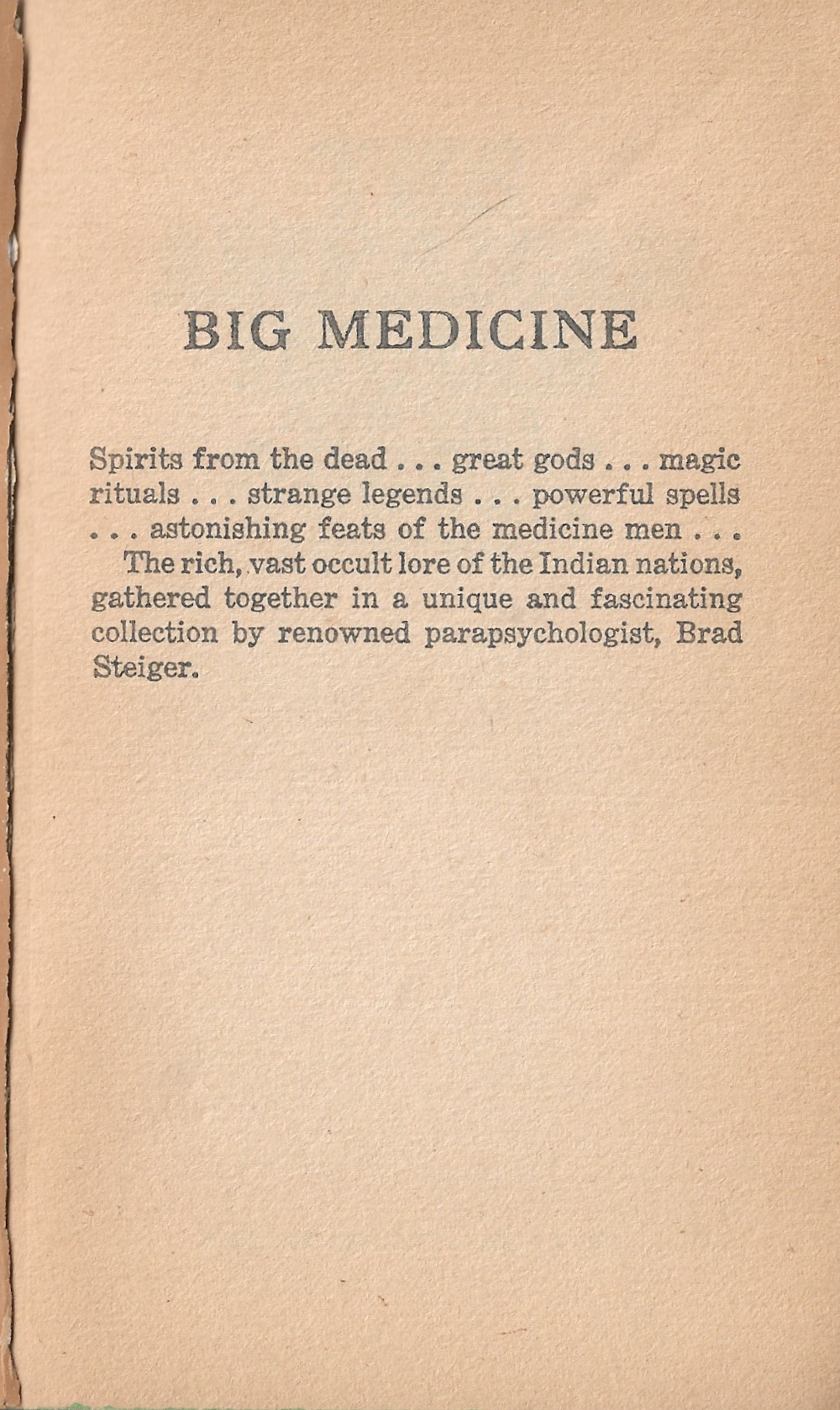
This purported guide to Amerindian occultism merely collects 35 quick hit chapters with no real analysis or through-line, making this another big pile of slop from bad, bad Brad Steiger working under his Christopher Dane pseudonym. Popular Library gave us a beautiful cover but slacks on the interior: we have typos here and there including chapter titles, and they even accidentally left Brad's true name on the inside cover!

What did readers make of this slip-up back then?

Steiger kicks things off with the Hartford Circus Fire of 1944. One Robert Segee confessed to arson in the case, and Steiger writes of vengeful Indian spirits compelling him to set the fire that killed 167 people and injured over 700. Segee would later recant his confession, but Steiger is content to finger him as the culprit and not get too involved in details about whether the fire was even really arson at all ...

Segee was supposedly of Native descent, by the way, which merits his inclusion here.

Moving on, there's no real structure as Steiger darts from outdated mystery mongering over sites like the Big Medicine Wheel in Wyoming and the Palenque ruins in Mexico, from peoples as varied as the Incas, Aztecs, Apache, and Haudenosaunee (Iroquois), with no attempts at delineation across two continents, countless cultures, and thousands of years of history.

Chapter 23, "The Sailors Who Came Before Columbus," discusses the Metcalf Stone of Georgia which purportedly illustrates pre-Columbian contact between Greece and the New World, while Chapter 29, "The Moon of Flowers," touches on Ancient Astronaut ideas around the Maya, in line with the Umlands' Mystery of the Ancients. Chapter 23 also mentions those famous Olmec heads and the Piri Reis Map - not by name though! Steiger is strangely subdued with his usual Fortean name checking.


Besides this de rigueur pseudoarchaeological mystery mongering, Steiger pads out his pages with the spectral threat of werewolf cults, vengeful ghosts, visions, killings and so on. These are in the classic Fortean maybe-fiction style of C.B. Colby and Frank Edwards, with nothing in the way of authentication or sourcing but plenty of invented dialogue and cheeseball scene setting:


Chapter 8 deals with the chindi or chʼįį́dii spirit, a malevolent force from Diné (Navajo) culture, of which Brad would later write a whole horror novel.

Two covers for this undoubtedly authentic chiller

Another real life horror is uncovered in Chapter 19, "The Manitou Grand Cavern Mummy," as miscreant Tom O'Neel (or "Jackknife Tom") is killed in a fight and then experimentally preserved by one Dr. Isaac A. Davis. Eventually Tom's corpse goes on the road as an "Indian mummy" ... yech!

Various just-so stories of uncertain provenance and bits of garbled history fill out the rest: Chapter 9 is an abbreviated account of Running Eagle, a warrior woman of the Blackfeet Tribe, here referred to as Weasel Woman. Steiger's version features dialogue like "Hooo, Ah," from rival Flathead fighters, go figure. Other chapters cover leaders like WovokaHandsome Lake, and Wabokieshiek. Sourcing is always thin regardless the subject.

Running Eagle, aka Pi'tamaka, aka Brown Weasel Woman

In style and content this volume straddles the classic "Dead Indian" era of frontier tales that was fading out by C.B Colby's time and the emerging New Age fascination with subjects like Hopi prophecy and general indigenous mysticism. Steiger was no stranger to this, whether here in the Americas, in "the Orient," or with the fraudulent Kahuna magic of Max Freedom LongNowadays we just have to seek out one of a thousand online "creepypasta" stories to find Amerindian concepts like skin-walker witches and the wendigo appropriated, sometimes mangled beyond recognition - reinterpreted from distinct cultural forms to generic oogy-boogy monsters.

True to form for Steiger's meatloaf volumes released as "Dane," the chapters are very uneven. Some are wisps that barely merit inclusion, some go on far too long for basic stories, some are obvious piffle and some are interesting enough. Chapter 32, "Many Scalps Has Laughing Wolf," surprises with a very measured history of scalping among Amerindians and settlers, analyzing the spread of the practice through bounties offered by settlers, and the difference between these bounty scalps, tit-for-tat atrocity scalping, and ritualistic scalping as practiced by a small number of tribes. Steiger was capable of decent writing when he put the effort in, and it's disappointing that the rest of this volume doesn't measure up.

Per usual, Popular Library doesn't bother with a table of contents or index.

Table of contents:

1.  Spirit Councils in the Forest of Fiery Death (5)
2.  Massau's Great Star: The Hopi Book of Genesis (11)
3.  A Wheel Older Than Memory (17)
4.  The Pyramid at Palenque (23)
5.  Where Are the Sheepeaters Now? (29)
6.  The Knife of the Arikaras (35)
7.  Death to the Apache Witch (41)
8.  Run From the Devil (47)
9.  Death Comes to the Woman Warrior of Two Medicine Lodge (55)
10. To Walk Among Rattlesnakes (63)
11. Roaring Thunder Returns From the Dead (69)
12. In Quest of the Medicine Arrows (75)
13. The Invincible One (83)
14. The Werewolf of Eagle Creek (91)
15. An Apache Head in Search of a Body (97)
16. Who Will Dance for Wovoka? (103)
17. Lake for Sale: Inquire of the Devil (109)
18. The Sign of Ubabeneli (115)
19. The Manitou Grand Cavern Mummy (121)
20. The Aztec God Demand's a Woman (127)
21. Tell Two Bears I Am Coming (135)
22. The Mysterious Hand of Gray Robe (141)
23. The Sailors Who Came Before Columbus (147)
24. The Rain Gods of Mesa Ecantantada (153)
25. The Secret of the Soul Eaters (159)
26. The Strange Dreams of Prince Viracocha (167)
27. Makers of Great Medicine (175)
28. The Amazing Empire of the Sun (181)
29. The Moon of Flowers (189)
30. The Good Gentle Words of Handsome Lake (195)
31. A Prophet of Another Sort (199)
32. Many Scalps Has Laughing Wolf (205)
33. The Search for Fons Juventutis (209)
34. Wabokieshiek Knows the Future (215)
35. To See the Spirit Home (219)

The American Indian and the Occult is available to read and download at archive dot org.

Popular Library, 1973