Showing posts with label berkeley books. Show all posts

Tuesday, December 30, 2025

THE SNAKE by John Godey


The urban jungle's about to meet the real thing, when a fully grown black mamba escapes into Central Park! Author John Godey was hot off his smash hit novel The Taking of Pelham 123, and a gritty horror thriller about a killer snake in NYC must have seemed like another surefire success.

All the pieces are there, including a charming herpetologist lead who understands all too well how the rest of humanity views his charges. And Godey unfolds the opening action with admirable ease, giving us that wonderful frisson of impending doom as everyone is one step behind our newly escaped snake ... but just as with Maryk and Monahan's Death Bite, the pacing turns sluggish, like a snake resting up between meals, and we find ourselves yearning for a bit more of the ol' blood and guts. Godey is too reserved, too realistic at times, whereas Maryk and Monahan at least went delightfully overboard with their giant Island Taipan and its bloodcurdling bite. Godey's attempt at colorful drama, the Jesus People freakshow cult that shows up near the end, feels underbaked. And the rather obvious twist at the end is hardly "the ultimate in horror," as the San Francisco Examiner claims. All in all, we could have used a touch of Mr. Brown and friends' sociopathy from Godey's much celebrated heist novel.

Hardcover edition

That's not to say it's all bad - just not as great as it could have been. Godey delivers the requisite city politics and panic just fine, and his characters are all finely drawn and relatably sad sack in that wonderful '70s way. Too, his use of Central Park is masterful (we're given those maps for a reason). There's just something missing in the final tally, and it feels like a letdown coming from Godey.

Dramatic NEL edition


This game that we animals play is a winner, but The Snake struggles with a 2/4 rating! For a second opinion, Will Errickson over at Too Much Horror Fiction offers a more positive appraisal.

As we finish 2025, man is STILL the prey!

A Berkeley Book, 1979 (original pub. 1978)

Saturday, August 10, 2024

THE NIGHT OF THE TOY DRAGONS by Barney Cohen


Albino mutant pygmy alligators! They're massing beneath NYC, their appetite rising to a fever pitch ... will we be prepared when they rise, and we face THE NIGHT OF THE TOY DRAGONS? And after slogging through Cohen's turgid technothriller drivel, will we care? Probably not!

Cohen's first victim is a sewer worker named Boggs, in a strange bit of synchronicity with David Hagberg's far superior Croc. Was there something in the water? The killer alligators act like cartoon piranhas, stripping bodies to the bone in minutes. At one point, they decapitate a police dog and somehow throw the head back at their human pursuers ... why? These cartoonish antics don't mesh with Cohen's wannabe verisimilitude of computer tooth analysis and bureaucratic infighting, and both aspects are crowded out by too much filler of midcentury character drama: home life, hookups, and the battle of the sexes. Cohen doesn't excel at any of these threads and the final effect is supreme dissatisfaction.

Eventually we get a final battle of flamethrowers vs alligators, but it's too little too late, and the story ends on a promise of more to come as the surviving characters gear up for yet another wave of invincible super-gators which simply elicits an eye roll. David Lippincott's comparable disaster dud Tremor Violet ended the same way, with more violence to come, but that was the one successful play in Lippincott's book. Here it's just another disappointment.

Author Cohen also wrote a couple science fiction thrillers, and ... a puff piece on Sting?

Pure terror ...

How doth the little crocodile improve his shining tail fail? Cohen's crocodilian cockup earns a 1/4 rating ... boo, hiss!

A Berkeley Medallion Book, 1977

Sunday, April 23, 2023

THE FURIES by Keith Roberts


The USA and USSR have cocked things up again in their struggle for world domination, this time detonating dual nuclear tests that blast a crack in the world and set the poor old UK on a collision course with intelligences from the outer spheres, energy beings that materialize in the form of gigantic wasps and immediately set about conquering our shattered planet. This is illustrator and ad-man Keith Roberts' first novel, and a helluva debut it is! He blends high concept cosmic slop with painful portraits of characters like Bill Sampson (also an illustrator in advertising) who should be living up the bachelor life but now finds himself thrown into the apocalypse, grasping out for others like poor little rich girl Jane and cockney slattern Pete, two female characters imbued with depth and power far beyond the usual genre standards of the time, or our time for that matter. Roberts does not shy away from human ugliness but he also approaches everything with a reserved humanism, and Bill's first person narration reflects a witty, understated understanding of our foibles and of life and death among the new rulers, the wasps. Yesterday Bill had a fancy flat, a dynamite sports car, and a loyal Doberman - but now it's all gone to pot, the car and flat smashed to bits and the hero dog just one more victim of the Furies. Communications from overseas are cut off, the government's dissolved, and would-be military saviors are reduced to scavengers along with the other survivors, as Britain slides into a new dark age under an alien dictatorship. Roberts writes with grit and emotion as Bill and company navigate this new nightmare world, jacking lorries and ransacking drug stores to survive while holed up in a cave, reduced to savagery while feeding off the corpse of the old world.

Comparisons to Ballard and Wyndham are inevitable and accurate, but Roberts does Wyndham's cosy catastrophe one better. The triffids merely reflected our self-inflicted impotence back at us - in the country of the blind, the crawling plant is king. The Furies, meanwhile, are truly a superior species, swarming in incalculable numbers as they sting and shred our soft, yielding bodies to pieces, dragging us from our boltholes and barricades, stopping at nothing in their alien quest to dominate. Part computer, part demon, so near to us and yet so far beyond our imagining, not simply a monstrous threat but the indicators of a paradigm shift so jarring that there simply may not be a place for us in the new universe. The wasps quickly enslave the remaining humans for menial labor in the massive hives now splattered across the English countyside, but Bill and the rest wonder how long this is going to last before they're expediently put out of their misery and endeavor to go out fighting instead. A perceptive review by Leonard at Goodreads notes that "the uppermost goal of our little band of resistance fighters is the destruction of edifices made of *pulp*. No SF critic in nearly a half-century has noticed this?!" Indeed, Roberts is operating on levels far above simple pulp SF action, and his Furies are at once stunningly phenomenologically plausible and also almost besides the point. In the same way that the grinding of the earth's crust may explode into an earthquake that leaves thousands dead, so too did some obscure cosmic twitch beget these Furies, who sever our gossamer thread of civilization in an instant between their vicious jaws.


Above, a Pan edition from 1969 with a lo-fi cover that seems to call forth the creature features that would swamp the UK market a few years later in the wake of James Herbert's The Rats - a story with its own bleak but simpler vision.
"The Keepers still haunt the conscience of mankind; I think in the end they justified the name we gave them so lightly. To us, they were the Furies."
The Furies rates 4/4, a masterpiece.

A Berkeley Medallion Book, 1966

Saturday, March 18, 2023

SHARK ATTACK by H. David Baldridge


SHARK ATTACK! Two of the most terrifying words together in the English language: a short, sharp stab of panic, of unthinkable misfortune and doom inevitable. Even before Jaws' block busting summer run in 1975 there was something in the water that decade, and it seemed like sharks were having their moment, thrusting out of the shadows of legend into our new jet age of science and reason, surging out into daylight but still draped in their mythic finery as demons of the deep. Scads of exploitation films and documentaries before and after Jaws were showcasing one of man's oldest, most implacable monsters in the most outrageous ways they could: 


Keeping with the dual traditions of fish tales and filmmaking, some of them couldn't help but sweeten the pot: the Burt Reynolds vehicle Shark! from 1969 for instance made promotional chum out of the supposed maiming of a diver during filming. Thankfully, it seems that it was all just typical exploitation ballyhoo for an otherwise mediocre (and shark-lite) film. For more examples of sharks in the popular culture of the time, the fine folks of the Men's Adventure Library have published an excellent collection of shark stories, succinctly titled Maneaters:


Amid all this overheated myth making and outright confabulation, enter H. David Baldridge, naval scientist and writer, who undertook the Herculean task of sifting through the International Shark Attack File in order to bring some order to the protean mass of Carcharian terror. The result was this book, possibly the densest and most factual of the many, many shark books released through the '60s and '70s. One previous entry of ours, Shark: The Killer of the Deep edited by Loren Grey, name drops Baldridge's work here for good reason. Baldridge's text is readable, his prose personable, and above all he is careful in his weighing of evidence and interpretation of fish tales - despite the cover blurb's invocation of Benchley's novel, not yet adapted into film at the time of this book's publication. 

For starters, we should know that the ISAF is a frustratingly fragmented resource, being as it can only contain reported attacks. Baldridge laments that documentation outside the former imperial core is thin on the ground, but he does the best he can with the fleeting news items and occasional rumors. On the other hand, American files yield many gruesome encounters, as do the Australian and South African archives. When you're inland in South Africa, by the by, beware the Zambezi sharks, so named for their habit of swimming hundreds of miles up the Zambezi River to occasionally attack the unsuspecting! Iran and Nicaragua also feature freshwater shark attacks, as does India's famous Ganges, the site of many religious water burials said to attract scavenging sharks. The question of sharks eating carrion is considered and answered in the positive, whereas many other concerns remain murky - would you guess that we don't actually know how well sharks can smell blood in the water, if at all? Again, Baldridge is thoroughly scientific in his approach and is always honest as to the limits of our current knowledge. The infamous New Jersey shark attacks of 1916 get a sober overview as well, adding to the freshwater carnage.


Unlike a lot of the trashier paperbacks on the subject, Baldridge avoids bloody victim photos and writes with dry appraisal of shark/human interactions. One humorous anecdote he relates involves the US Navy's "shark chaser" formula, an anti-shark liquid supplied to pilots in the event of a water landing. Baldridge reveals that the Navy had quickly deduced that shark chaser had little to no effect on sharks (its primary target mind you), but that the psychological value to downed pilots was so valuable as to necessitate its continued kitting. Sharks attacks are, after all, exceedingly rare, as Baldridge reminds us often through the text, and so the practical uselessness of the formula was actually a very small kink in the face of its overall effectiveness. And surprisingly or not, more often than not, poor relations are a direct result of provocation from Homo sapiens, as Baldridge relates of many people who thought it great fun to grab a little shark by the tail, or toss grenades overboard, and found themselves gnawed or exploded for their troubles - the grenades were courtesy some GIs disposing of old stock, and their intended victims swam directly under their boat after ingesting the explosives, sending all involved sky high. Baldridge can't resist gloating a little at these just desserts: all the sharks are doing, after all, is living their best lives, as they've lived for hundreds of millions of years.

We stop over in Florida to visit ichthyologist Eugenie Clark, working at her lab on cutting edge shark research. Clark is an appealing figure, taking scientific research into the primal realm of her subjects. In her own memoir she dubbed herself the "lady with a spear." A modern article on Clark yields these great photos:


Our global tour of shark attacks doesn't just list the heavy hitting man eaters like the massive Great White or the voracious Tiger, but plenty of dark horses and also rans such as the Bull Shark (a frequent freshwater interloper), the small and scruffy Wobbegong (scourge to Australian fishermen caught in its tenacious jaws) and Zane Grey's old fishing foe the zippy, snippy Mako. The variety and range of shark species and their spectrum of interactions with humans, sometimes banal, sometimes horrific, is as much a part of Baldridge's story as any of the "classic" images of what a shark attack entails. Australian and South African beaches do their best developing anti-shark measures, testing nets and lookout guards as well as kooky electronic systems. Pearl and abalone divers in California and the South Pacific may or may not carry bang sticks or spears, but they learn not to dawdle with their catch regardless, and here Baldridge does conclude pretty solidly that keeping dead fish on your person underwater is a surefire way to initiate a close encounter with sharks! Various islanders and coastal peoples around the world deal with maddened sharks who seem obsessed with ramming their dingys and canoes, and here Baldridge isn't quite sure what the sharks are thinking. But whether or not he has the answers, he's asking the right questions, and with that, there's not much else to say! 

For its methodology and historical value, Shark Attack proves fascinating reading almost 50 years on and a worthwhile addition to any curious reader's library. It's available to read and download at archive dot org.

A Berkley Medallion Book, 1974

Wednesday, June 15, 2022

THE ADAM EXPERIMENT by Geoffrey Simmons


"When the first child is born in space the final horror will begin ..." Howzat do ya for high concept horror? We're updating the usual ET agenda away from nuts and bolts milestones such as our first atom blasts and radio waves pouring into space towards the most personal, biological subject possible. There must have been something floating on the cosmic winds around this time because Alien debuted contemporaneously, presenting the final word on outer space body horror. To avoid suspense, I'll have you know The Adam Experiment isn't a patch on Alien's terror. It's more in line with the grubby imitators such as Inseminoid or Xtro, managing some effective moments here and there but largely limp and unfulfilling. The publishers also manage to typo the author's name right on the inside cover!

For starters, we're in the far flung year of 1991, with the mighty Space Lab V and its crew of 3,000 (!!!) orbiting 300,000 miles out from Earth. Near future SF settings are always tricky, and here Simmons stumbles a bit - why exactly is this gargantuan super sci-fi spaceship necessary for what's attempting to be a plausible, grounded thriller? We dance around the central conceit of a pregnancy in orbit for far too long as well, filling up time with dead end plotting which leads me to think that Simmons simply wasn't up to the task of fleshing out his own ideas. There's some nice suspense at the beginning, as a NASA tech receives notice from Pioneer 10 that its internals have been accessed - that's accessed, not destroyed or blown open, by something out there beyond the solar system ...  something that now has a map back to Earth.


Soon we're zipping up to Space Lab V with our main characters including Dr. Cortney Miles, "a skilled researcher whose long blonde hair and model's figure seemed more suited to a fashion show than a row of test tubes." Ha! We faff around for a while with experiments and scientific rivalries before we finally get down to business: the beast with two backs, in space! And here's where the terror, such as it is, begins. Something is coming, from out there. It's alien, unknowable, uncommunicative. And we are utterly helpless.

Spoilers here, for the better parts of the story: the aliens are huge, biological monstrosities, miniature planetoids covered in horrible eyes. Upon reaching Earth they gently deposit Pioneer 10 onto Space Lab V, with one major, frightening alteration: the woman on the plaque has a hole drilled through her womb! For whatever reason, they don't want us breeding beyond our planet. At the same time, they somehow are abducting hapless humans from our planet's surface and medically mutilating them! Here are some effective scares, as the aliens' POV is simultaneously sinister, logical, and totally opaque. The climax builds effectively as well, minus one little detail: the note "To be continued ..." What a rip!

Classy hardcover edition

Author Geoffrey Simmons is a bit of an odd duck. I'll let him speak for himself:
I am physician who is Board-certified in Internal Medicine and Disaster Medicine. I have a B.S. in Zoology and I have completed the course work for a Masters degree in Microbiology. I am also a Fellow with the Discovery Institute Center for Science and Culture. I have studied the theory of evolution for over forty years. For thirty of those years I was an ardent supporter of Darwinian ideas. I now, however, find the data supporting this theory scientifically untenable.

Our history strongly suggests we are here, at least in part, to re-create human facsimiles, called humanoids. One can readily see a constantly improving, convergence of designs over time. We are now copying many of those designs. This book braids human capabilities (designs) together, such as vision, ambulation, hearing, tasting and consciousness, using the two standout, contemporary explanations of our origins, i.e. Intelligent Design(ID) and the theory of evolution. This book shows that evolution, if it is to be believed, requires a lot of Intelligent Guidance (sometimes called the God of the Gaps). Just the changes needed to go from cold-blooded animals to warm-blooded animals would require several the entire texts of thick chemistry, biology and physics books. Or, from land mammals to sea mammals. Or walking animals to animals that control flying, landing and nesting in trees.
He never wrote a sequel to The Adam Experiment, though he managed a couple other thrillers before devoting himself to Creationist texts. For some creeping fear bogged down in pedestrian plotting, The Adam Experiment earns two starchilds out of four:


A Berkeley Medallion Book, 1979 (original pub. 1978)

Friday, February 11, 2022

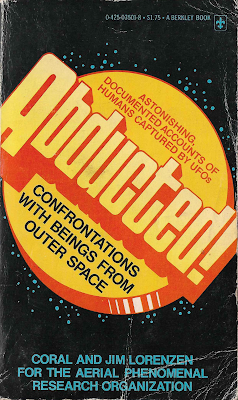
ABDUCTED! by Coral and Jim Lorenzen


Influential UFO researchers Coral and Jim Lorenzen give us this summary text of a few wild years when multiple people across America found themselves ABDUCTED! The Lorenzens and their UFO group the Aerial Phenomena Research Organization were among the first to pay serious attention to tales of flying saucer occupants, in a time when other researchers were writing close encounters off as contactee-level drivel. Persistence pays off though, and by the 1970s the UFO field was shifting to an acceptance of close encounters and a new term entered the lexicon: the alien abduction. Much of the foundation for these cases rests on hypnotic regression as practiced by doctors such as Leo Sprinkle, which is to say that things are off to a shaky start at best. But let's see just what the Lorenzens have to say about these astonishing, documented accounts of confrontations with beings from outer space ...

Jim and Coral lookin' fly

The abductees are:

George Wheeler, Wisconsin 1976. Police officer abducted while investigating a strange light he thought may have been a fire. Multiple witnesses testified as to something strange happening that night. Wheeler initially blocked out the memory of his experience, which the Lorenzens note as an emerging theme in alien abductions of the time, also mentioning the Hills and Antonio Villas-Boas.

Pat Roach, Utah 1973. Abducted with her children by medically minded aliens. Anonymized as "Patty Price, from a midwestern state" as Roach did not originally want publicity for her experience. Next year however she would appear on an episode of In Search Of. Longtime UFO researcher Kevin Randle takes some issue with her case, or more properly with her hypnotic regression performed by APRO investigator Dr. James Harder. According to Randle, Dr. Harder discussed details of the Hill's experience with Roach during her session, unduly influencing her recall. Randle was Harder's assistant on the case, but if he had these misgivings at the time the Lorenzens did not include them in their summary! Incidentally, Isaac Koi's website for Ufology has a very useful index for references to this case in the UFO literature.

Carl Higdon, Wyoming 1974. Abducted while hunting elk by Ausso the Alien, and given a tour of Ausso's craft. Ausso acts like a classic contactee Space Brother. He was able to stop one of Carl's bullets in midair before revealing himself. Leo Sprinkle investigated and arranged a polygraph for Higdon.

Higdon with wife Margery ...

She wrote the book on him!

Charles Moody, New Mexico 1975. Airborne Sergeant Charles Moody was abducted from Alamogordo after watching a meteor shower. His case includes classic features such as a car that dies or won't start, missing time and amnesia, and lingering health effects with a "heat rash" on his lower torso that developed afterwards. His case was investigated by the Lorenzens simultaneously with Travis Walton's. Moody's aliens would not use his nickname Chuck and insisted on calling him Charles - proper little fellas!

Moody and his friends

Sandra Larson, North Dakota 1975. Abducted while driving with her daughter and boyfriend. Other contemporary reports played up the bizarre beings, which Larson described as "mummy like" creatures with jointed arms like an erector set. They performed weird medical procedures on her such as rubbing her body with a clear fluid! Larson was hypnotized by Leo Sprinkle and the transcript is included herein.

David Stephens, Maine 1975. Also abducted while driving with a friend. A gigantic UFO shot a beam at their truck and then ... missing time, missing memories. Dr. Herbert Hopkins, who preformed Stephens' hypnotic regression, would later claim a visit from the Men in Black! An emotionally fraught case if there ever was one.

Travis Walton, Arizona 1975. This is the big one, the whole enchilada. Out of all the cases in this book Walton's had the staying power, and if you're not already familiar then I doubt I could do it full justice in this rundown. The Lorenzens are fully convinced of his truthfulness, while skeptics such as Philip J. Klass disagreed. My opinion? However you appraise Walton's character, actual evidence seems rather thin on the ground ... (Edit: see Charlie Wiser's convincing analysis of the case which concludes hoax.)

Two books on the Walton case

APRO was all in on Walton

Louise Smith, Elaine Thomas, and Mona Stafford, Kentucky 1976. A truly strange triple abduction! The ladies were taken while driving at night, and their case caused such a stir that THREE major UFO groups wound up tussling over the investigation: APRO as represented by Leo Sprinkle, Hynek's CUFOS, and MUFON! Eventually Sprinkle was able to hypnotize Mona Stafford and arrange a polygraph for all three ladies.

Louise, Elaine, and Mona

Charles Hickson and Calvin Parker, Mississippi 1973. The famous Pascagoula abduction. The Lorenzens saved it for last in order to trace the possible effects its major publicity had on the other cases. The next chapter starts to collate everyone's experiences, with the Lorenzens theorizing a plan of human experimentation by the UFO occupants. The authors are bullish on UFOs being nuts and bolts craft for ET, and poo-poo talk of interdimensional travelers - man has been to space, after all, but not yet to "another dimension," whatever that might even mean! Point taken, Jim and Coral.

We get two beefy appendixes, with a transcript of one of Travis Walton's polygraph tests and an article by Leo Sprinkle on using hypnotic regression for UFO cases. A long list of references follow, and what should catch my eye but a citation for Eric Norman's Gods, Demons, and UFO's? That's not a very reliable source, you guys! It seems we just can't escape the pulp origins of Ufology no matter how high we set our sights. We're dreamers in castles made of sand ...

A Berkeley Medallion Book, 1977