Showing posts with label crocs. Show all posts

Tuesday, December 31, 2024

MAN IS THE PREY by James Clarke


Danger from above, danger from below, danger from every living thing ... for our final entry of the year author James Clarke lays down the law: MAN IS THE PREY!


A beefy book with a simple concept: animals that kill people. All of 'em, all over the world, but especially Africa as that was Clarke's remit. Clarke horrifies with tales of killer beasts, but he also equivocates when necessary. Consider his thoughts on the gila monster, a controversial "man killer" in the literature:
A number of people who ridicule the idea of the gila monster's [bite] being lethal to man claim that those who died after its bite were all alcoholic or sick. Curiously it seems a great many of them were, but then if an alcoholic is knocked down by a bus did the bus kill him or did the alcohol?
The "deadly" aspect of an animal may be variable, and down to circumstance. Is the elephant more dangerous than the lion, than the hippo, than the croc? Do raw numbers of victims tell it all, and do we even know the true numbers? Does any of that matter when you're the one getting chomped? 


Above, the original hardcover edition with a back cover cameo from a chacma baboon. Clarke's careful treading elevates his book above a simple chronicle of misery and helps us think about our place in nature, as a part of nature despite our best efforts. Owing to its era, much of the color comes from big game hunters and safari tales. Goodreads reviewer Brett Dulle has an insightful review which helps put certain parts of the book in context:
The book has two clear biases:

1. The author is an ex-pat living in South Africa and as a result the book is more focused on African wildlife than other countries dangerous animals. For example, his chapter on crocodiles is almost exclusively about the Nile crocodile. It's hard to criticize him for this because it is obviously much easier to write about what you have a personal experience with and these firsthand accounts are the most interesting parts of the book.

2. The author has a strong interest in big game hunting. My estimate is that over half of the information in the book comes from big game hunter's memoirs or conversations with big game hunters. This effects the coverage of different animals. The crocodile, an animal the author admits is probably the most voracious man-eater, gets 10 pages while the elephant gets 20 pages of coverage. As the book moves away from the big game animals, it feels more like he's simply listing off facts about these animals and the book starts to drag. Again, it's hard to complain since the stories of the big game hunters are usually quite exciting.

These foundational biases aside, the author also takes sides with some of the animals. Bears are depicted as practically harmless while wolves are ravenous hellhounds that, according to a story he reprints, almost ate an entire village in one night.
Another example of Clarke's personal views coming through is his treatment of the killer whale. Despite no real hard data about orcas eating or killing humans, he takes it as read from anecdote and reputation that the fearsome predator is a known, guaranteed killer. After all, no less an authority than the US Navy says that orcas "will attack human beings at every opportunity." And would you want to test that out yourself?

James Frederick Clarke (1934-)

The final chapter details the most dangerous animal to man: himself. The second to last chapter covers insects and arachnids, and delves into disease and famine - we know the mosquito is one of the deadliest creatures on earth, due to its transmission of a multitude of diseases. Bees and wasps can kill through swarming by the thousands or from one single sting on someone unlucky enough to be allergic. How does this stack up against a tiger's fangs or a shark's jaws? How much does public health and policy factor into a focus on deadly animals? It's not so easy as a top ten list but the journey is rewarding.


That ol' showman Ivan T. Sanderson shows up in Clarke's bibliography with a book on elephants, The Dynasty of Abu. Famous tiger man Jim Corbett features as well ... of course! It wouldn't be much of a book on killer animals without the hunter who bagged the Man-Eaters of Kumaon among many others!

More of man against nature ...

Lions, tigers, bears ... sharks, snakes, and things that sting! Killers from legend and in the laboratory, who kill for food, for self defense, or just for the hell of it! Clarke catalogs them all, and we're all the better for it! Man is the Prey is well worth picking up even today, as both a snapshot of an era and a thoughtful, expansive exploration of its subject. Grrr, hisss, ahhh!

Panther Books edition

Another hardcover, with a goofy snapshot!

Clarke's excellent text is available to read and download at archive dot org.

Pocket Books, 1970 (original pub. 1969)

Saturday, August 10, 2024

THE NIGHT OF THE TOY DRAGONS by Barney Cohen


Albino mutant pygmy alligators! They're massing beneath NYC, their appetite rising to a fever pitch ... will we be prepared when they rise, and we face THE NIGHT OF THE TOY DRAGONS? And after slogging through Cohen's turgid technothriller drivel, will we care? Probably not!

Cohen's first victim is a sewer worker named Boggs, in a strange bit of synchronicity with David Hagberg's far superior Croc. Was there something in the water? The killer alligators act like cartoon piranhas, stripping bodies to the bone in minutes. At one point, they decapitate a police dog and somehow throw the head back at their human pursuers ... why? These cartoonish antics don't mesh with Cohen's wannabe verisimilitude of computer tooth analysis and bureaucratic infighting, and both aspects are crowded out by too much filler of midcentury character drama: home life, hookups, and the battle of the sexes. Cohen doesn't excel at any of these threads and the final effect is supreme dissatisfaction.

Eventually we get a final battle of flamethrowers vs alligators, but it's too little too late, and the story ends on a promise of more to come as the surviving characters gear up for yet another wave of invincible super-gators which simply elicits an eye roll. David Lippincott's comparable disaster dud Tremor Violet ended the same way, with more violence to come, but that was the one successful play in Lippincott's book. Here it's just another disappointment.

Author Cohen also wrote a couple science fiction thrillers, and ... a puff piece on Sting?

Pure terror ...

How doth the little crocodile improve his shining tail fail? Cohen's crocodilian cockup earns a 1/4 rating ... boo, hiss!

A Berkeley Medallion Book, 1977

Friday, April 19, 2024

'GATOR by George Ford


Only 8mg tar? I can't believe it!


"... and Merv Griffin!"

"She's sure making a lot of noise." The screams from the wounded woman on the ridge behind them echoed through the swamp. The black laughed again. "Women don't like pain," he chuckled. "They figure it hurts." Then he stopped laughing just as suddenly; his voice dropped low and became menacing.

"Now let's move it," he growled. "We haven't got all day."
More terrifying than Jaws?

Don't bet on it. Anonymous author George Ford (a pseudonym?) delivers a competent but unexceptional potboiler about a gang of crooks who cross paths with - who else? - one pissed off gator.
Animal lovers beware, the first victim is Puff the Poodle, and he doesn't go easy. His owner Anna Ekberg wasn't even supposed to be here, but horny criminal Harvey couldn't resist picking up the sexy diner waitress on his long drive out to the swamp. He's meeting Steve, George, Cop, Eddy, and a couple other guests for a big drug connection, and their faffing around accounts for too much of the opening action, or what passes for it.

We could have done with one or two less goons filling out the cast as well, considering how much they blend together - is it Eddy or Arthur or George who's the old man? Which one's the asshole? Trick question: it's all of them. There's lots of angry guys shouting and growling and telling each other to shut up, and it reads as filler.

After Puff gets got, the gator starts chomping arms and legs, and the pace picks up a bit. When kingpin J.C. and bodyguard Mattie arrive, we finally get humming with some crossbred Southern fried crime and animal attack action, but it's too little, too late. A crashed plane and gator breeding ground aren't half bad action set pieces  ... but again, it's too little, too late. Maybe Ford should be commended for his immersive style, because we really do feel like we're wading through stagnant water here.

In the final push, Ford sticks the landing with a pretty good climax as things go SNAFU, and the downbeat ending is predictable but executed with a modicum of grace. 'Gator lackadaisically chomps its way to a 2/4 rating.

Award Books, 1976

Monday, October 23, 2023

CROC by David James


"In the twenties it started," Boggs began, but then he stopped. Andrea was staring at him, disbelief in her eyes, but waiting for him to continue.

"All the rich bitches from uptown were raising hell, going to parties, driving their fast cars, putting in swimming pools in their penthouse places. But it got boring after awhile. No one was satisfied. They wanted something new, something different. So some of them began stocking their pools with baby alligators and crocodiles. Only the fad didn't last long, so they dumped the things down the sewers rather than kill them."
David Hagberg returns as David James for another pseudonymous thriller, following up his disaster novel Blizzard with some real creature feature carnage in Croc! NYC sewer worker Boggs loses his partner Fascetti to an impossible monster after probing a cave-in off the cross-town line, and after almost getting chomped himself he's press-ganged by Fascetti's widow into returning to the sewers with a .45 to kill the beast!

Things do not go as planned. In Hagberg's universe this is down to both institutional problems and the vagaries of the personalities involved - and boy does Croc have some characters! Boggs is a rummy lifer working the shit detail in the Sanitation Dept., and Hagberg spins some eloquent characterization as he contemplates what amounted to his life, staggering knee-deep through the pitch black sewers (with a shitty '70s flashlight, batteries draining fast) pursued by the monster croc - dreams, failures (many), and what-ifs and could-have-beens, some involving his dearly departed partner Fascetti, who almost (almost!) named Boggs his firstborn's godfather.

If you ever had to use these, you know Boggs is doomed ...

Andrea Fascetti, meanwhile, was all set for a good life as a good wife, and now has to clean up this fucking mess, which she splits 50/50 between the croc and Boggs. Her iron core - hidden inside a Talia Shire type beauty which the male characters are by turns enraptured, aroused, and a little frightened by - might never have come out if not for this tragedy, and makes one consider the multitude of invisible lives of midcentury housewives, forever standing behind their husbands. As things spin out of control, the authorities finally plunge into action, and here again Hagberg draws us in with a cast of cops, scientists, and bureaucrats who could have been cardboard cutouts but instead are all either a bunch of fuckups, barely holding it together, or just plain weird! His reptile expert Koch gives us just a light info dump on crocodilians, telling us that based on size and disposition our killer is most likely a saltwater crocodile - he's thriving down in the sewer, too, because they like brackish water! This quick rundown is typical of Hagberg's light touch - he never lingers on genre conventions when we've got enough of an idea to keep moving. In fact, even though his
Croc ultimately has a low body count comparable to Katz's Alligator, Hagberg moves things so fast and furious that we never feel cheated. The setting, characters, and monster feel authentic without over explanation, and Croc can rest comfortably as an accomplished monster mash right next to John Sayles and co.'s 1980 film Alligator  - though Croc lacks that film's sharp satire, aiming for more resigned humor from Hagberg's cast of screwups and freaks. Hagberg does get some sly jabs in with Bremberger, the up-and-coming pol whose attempts at self-promotion through crocodilian crisis get shot down at every turn.


Croc (or Croc') was originally graced with the crackerjack man-vs-beast cover above, courtesy its 1976 debut from Belmont Tower Books. The New English Library edition lacks a certain dynamism by comparison, despite a decently fierce croc and a hard-to-see hand slipping beneath the sewage. NEL doesn't miss a trick plugging its moneymaking Crabs series from Guy N. Smith though!

Croc is available to read and download at archive dot org. For some lean, gritty thrills, Croc earns 4/4 stars.


New English Library, 1977 (original pub. 1976)

Friday, October 13, 2023

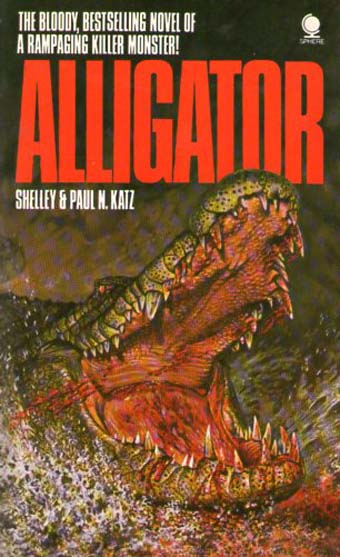
ALLIGATOR by Shelley Katz


"Don't go," Luke said, "listen to me." His voice echoed in the quiet. Same had never heard three hundred people be that quiet. "I've lived a long time. I know the swamps better than any of you. You don't stand a chance against that alligator. He's too old and too tough. Nature is on his side, not yours. Take my advice, stay here where you belong. Stop now while you can. Don't you see? I can feel it. That ain't no gator you're courting. It's death."
Two gator poachers don't make it home after tangling with a 20 foot monster alligator. What's left of them sends the town of Glades, Florida into a panic and then a frenzy, as word travels and the outside world comes crashing in with rubberneckers galore and a select few men who aim to kill the beast. One of them is local boy made good Rye Whitman, now a high powered Miami real estate dealer, his own kind of apex predator. But if he's to survive the treacherous swamplands, he'll need local guide Lee Ferris. Lee made it out of Glades too ... to Vietnam. The things he did there followed him back to Glades, and he doesn't have much use for people in general. A shark like Whitman? Even less so ... Except something is drawing them together, into this doomed, mythical quest to kill the alligator, and they'll need all of Lee's bushcraft and Rye's animal cunning if they're both to survive. But after everything the everglades throws at them, they might not care.

There's strong writing here, with plenty of rich characterizations, pungent Southern melodrama, and a sense of fun that's often missing from so-called "elevated" or literary horror (dig that jello!) but Alligator also suffers from a slack middle and a monster star that's MIA for too much of the story! Katz even loads us up with a convoy of gator bait following leads Lee and Rye into the death glades, but then lets most of them off easy as they each eventually turn tail from the challenge. The bodycount is frustratingly low. Even so, you'll be carried along with Lee and Rye through an onslaught of stinging, biting insects, the burning sun, cutting sawgrass that grows 6 feet high, and always the stinking, sucking waters of the swamp  - Katz does a knockout job on the setting, both the rotting shithole town and the endless, trackless green hell beyond.

Alligator must have made a big splash, because there's multiple foreign editions. The Sphere editions are co-credited to husband Paul. There's also a handsome reprint from Centipede Press which came out last year, limited to 500 copies at $125 a pop - but only $95 if you're okay with an unsigned copy!


Variations on a theme ...

Shelley Katz is still writing today at her blog, and also recently edited a "crowd writing" collection of true stories from real people.

Our author

The cover on the classic Dell paperback looks like it should be a stepback, but it isn't, though the scales are embossed for a cool texture effect. The full gorgeous painting is confined to the back cover. 


Alligator still gets good reviews nowadays (note that this reviewer also mentions pacing issues), and its inclusion on a top ten list by David Foster Wallace may prejudice you one way or the other. Don't worry about that! For its fear-soaked atmosphere and sweaty Southern melodrama, Alligator earns a solid 3/4 stars.

Dell Publishing, 1977