Showing posts sorted by relevance for query ellen. Sort by date Show all posts

Thursday, September 9, 2021

THE BERMUDA TRIANGLE CALENDAR: July - September 1975


Those deadly Dero rays did their damnedest, but we've made it back alive with more entries from Lawrence David Kusche's Bermuda Triangle calendar of 1975! Highlights from this three month stretch include the search for the lost USS Scorpion (not found until October of 1968), the sad and bizarre story of Donald Crowhurst's doomed race against time, and some classic Triangle tales of Columbus' spooky sailing to the New World. September features a lovely painting of the Sargasso Sea by one E.S. Hodgson, a semi-obscure figure who benefits from this biographical sketch by researcher Robert J. Kirkpatrick. Here's that piece in color:


The Sargasso Sea makes a handy segue into the resolution of a minor Triangle mystery - the story of the Ellen Austin, an apocryphal entry in Kusche's The Bermuda Triangle Mystery - Solved: 


Fortuitous happenstance has provided a solid answer to this case. The tale of the Ellen Austin and the derelict happens to match beat for beat the first half of a short story titled "The Mystery of the Water-Logged Ship" by classic horror author William Hope Hodgson. The story is a minor one from 1911 and perhaps overshadowed by his other, more fantastic sea stories such as The Boats of the "Glen Carrig" ... for despite the mysterious setup, the second half of the story reveals that perfectly corporeal pirates are to blame, utilizing a hidden chamber on the derelict to ambush victims seeking salvage! The Triangle myth simply drops the clever denouement and leaves the mystery, pregnant with otherworldly menace.

Lawrence David Kusche, 1974

Wednesday, February 16, 2022

WEIRD UNSOLVED MYSTERIES by Eric Norman


Brad Steiger dons his alter ego Eric Norman and invites you to enter the doorway to the strange and discover some WEIRD UNSOLVED MYSTERIES! Presented with a verve and panache that rises above his Popular Library fare, this volume is a tidy little collection of themed mysteries, with a great table of contents courtesy Award Books - ol' Popular Library never bothered with that! Presentation counts, and even though this is the usual remixed slush pile from Steiger, it somehow seems fresh and intriguing, even as the thought starts to tickle the back of our brains, now where have I read this before?

Chapter one, for example, opens with missing child Tommy Bowman, who disappeared on a family hike in 1953. Steiger intones mysterious happenings of a trans-dimensional nature, though the truth seems far more prosaic, and sadder too, as Bowman likely was an unnamed victim of serial killer Mack Ray Edwards. Steiger will reuse this case, and pretty much this entire chapter, in his Strange Disappearances in 1972, just jiggling some words around. The missing Chinese army, the fictional Charles Ashmore, they may have all disappeared (or not) but they reappear in these pages over and over. A chapter on sea serpents follows, with many vintage 1800s case reports that buddy Warren Smith would paste into his Strange Secrets of the Loch Ness Monster in 1976, and some hoax accounts of the Lake Vorota monster of Siberia - which, to be clear, is a "real" unknown creature, with sighting reports that continue to this day. However, Steiger's claims of the monster devouring dogs and elk and an "undetermined" number of people are classic ballyhoo, adding just a little spice to a story to stretch it that much further. He also misspells the location as "Vororta" - go figure.

Next are ghost ships galore, and as we might expect the crew of the Ellen Austin performs their usual dramatic disappearing act. Various vessels are lost in the Bermuda Triangle before we move on to some classic spontaneous human combustion, and then unearth some mysterious artifacts like the Kensington Runestone. Steiger also gallantly defends James Churchward and his Mu fantasy against the snobby "sophisticates" with some cutting edge developments by botanist Dr. Albert C. Smith, who found "an overwhelming affinity" between Fijian and New Guinea flowers, which Steiger says is proof of an ancient  landmass stretching across the ocean. Balkan pyramids and super civilizations are another mystery that lingers in the present day.

Steiger's penultimate chapter is a knockout on monsters of all shapes and sizes. Strange sightings from South America would be reused by Warren Smith for Lost Cities of the Ancients - Unearthed! in 1976. Nice selection here by Brad. His final chapter is on fairy folk with a sidebar into their possible UFO connection. Charmingly, Steiger posits the alien babe who made it with Antonio Villas-Boas as a possible fairy queen! I like it. We also get a credulous bit on the Cottingley Fairies and Sir Arthur Conan Doyle, with technical arguments about the (im)possibility of hoaxing that sound similar to those marshaled for certain other mysterious creatures. Steiger ends on a high note though when he offers us a passport to Magonia, and ponders the "kernel of reality that may lie at the core of centuries of myth and legend." Bravo to Brad for this clean delivery of some old reliables. It must have paid the rent!

These Weird Unsolved Mysteries are available to read and download at archive dot org.

Award Books, 1969

Saturday, November 14, 2020

STRANGE ESP by Warren Smith


Warren Smith continues his STRANGE saga through Popular Library with this entry from 1969, focused on ESP. There's men with "Computer Eyes" and "IBM Minds" and good ol' "X-Ray Vision!"

Smith revisits railroad tycoon Arthur Stilwell, last seen in Brad Steiger's Beyond Unseen Boundaries. We also get a reprise of the well-worn stories of Clever Hans and Jef (or Gef) the Talking Mongoose. "Doc" Anderson rates two whole chapters, although really the second one could have been folded into the first, being concerned solely with a brief anecdote of Jackie O's post-Camelot nuptials. The predictions listed in his first chapter don't add up to much either, come to think of it! Anderson was a regular subject for Smith and Steiger. Japanese artist Kyoshi Yamashita gets a very unflattering chapter which focuses on his status as an "idiot savant" and doesn't include anything vaguely related to ESP!

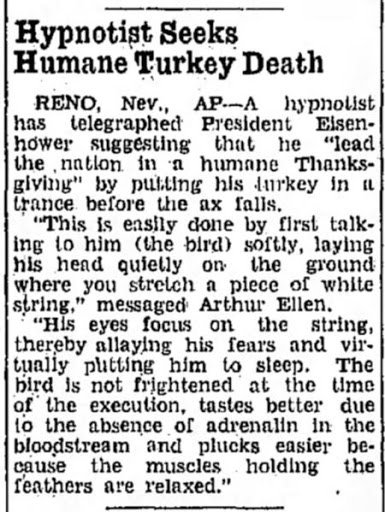
There's a heavy load of celebrity entries, including Eartha Kitt, David Niven, and Hypnotist to the Stars Arthur Ellen. Geronimo and Teddy Roosevelt make a fine pair of historical persons tangentially connected to psychic phenomena, while President Garfield's assassin Charles Guiteau takes things in a more sinister direction.


The silliest chapter title in this volume? My money's on "Deadly Vision of Death" ... it's double the deadly! This title is available to read and download at archive dot org.


Popular Library, 1969

Saturday, January 15, 2022

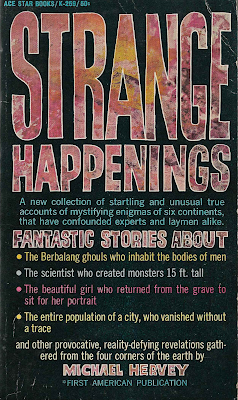
STRANGE HAPPENINGS by Michael Hervey


Another Fortean free-for-all by Michael Hervey, this time split between legitimate historical weirdness and fantastical nonsense. Such strange-but-true factual cases include the so-called "Elephant Man" Joseph Merrick, the Collyer Brothers who famously perished inside their hoarded NYC apartment, Jack the Ripper, and the hypothetical planet Vulcan which was proposed to exist between Mercury and the Sun. We stray into fantasy land with accounts of Atlantis, the Shroud of Turin, and the Count St. Germain, though Hervey's eclectic selection of stories is appreciated. The 1900 disappearance of the Flannan Isles lighthouse crew is one mystery that still persists today, although Hervey's invocation of sea monsters and pirates seem unlikely solutions.

Hervey mentions the mystery ship Joyita again in passing, this time wondering if yet more sea monsters ate the passengers and crew alongside some other missing ships in the South Pacific. At this point we see that the story of the Joyita is so well established that Hervey can simply toss the ship into some random mystery mongering with no real connection to the facts of the case. The apocryphal Ellen Austin also shows up, with some invented dialogue of superstitious sailors scared of the kraken! This is yet another illustration of how these stories evolve to become spookier and spookier as successive authors add flourishes and invent new details. 


Despite Hervey's freeness with the facts, he has a sharp eye for subject matter. Rather than recycling endless ghosts, UFOs, and ESP tales ad nauseam he sprinkles in some real shocking stuff like Australian Aboriginal death curses and the Berbalang ghouls of the Philippines. Careful with those ghouls, though, because "published information on the subject is based on a single report by Ethelbert Forbes Skertchly, a resident of Hong Kong and an officer in the British Navy." Wikipedia continues:
Skertchly's article in the Journal of the Asiatic Society of Bengal also attracted the attention of English academic and ghost-story writer M. R. James, who in turn introduced it to Rupert T. Gould circa 1911. Gould discussed the subject and reproduced Skertchly's account of the Berbalangs in a chapter of his popular book Oddities, first published in 1928. Modern awareness of the Berbalang lore largely derives from Gould's book.
Talk about some strange happenings! 

Ace Books, 1966

Thursday, February 23, 2023

TERROR ZONES by Adi-Kent Thomas Jeffrey


And it's terror time again as that titan of triangular tomes, Ms. Adi-Kent Thomas Jeffrey, takes us through a gripping global tour of TERROR ZONES! Right off the bat we have one of countless appearances in the paranormal literature by the apocryphal, untraceable death ship SS Ourang Medan, adrift in the Indian Ocean with a slaughtered crew, victim to some unknowable force from beyond. The Comte de Perouse disappears on a mission for France in 1789, and earlier still Dutch captain Bernard Fokke sails on a Sunday in 1650, cursing himself into history as the Flying Dutchman! In this opening chapter with the Indian Ocean, Adi-Kent outlines her thesis on the "terror zones," areas where the normal rules of time and space can suddenly be suspended. Ivan T. Sanderson's vile vortices get name dropped, and Jeffrey uses terror zones, triangle zones, and vile vortices interchangeably throughout the text, leading to some odd configurations:


How exactly are we supposed to orient our deadly triangles in the Indian Ocean? Never mind that, we're on to the next stop and a good one, the dreaded Sargasso Sea! Already we have the tone for Adi-Kent's text: lots of cheesy recreations with invented dialogue and events and less than rigorous historical sourcing. Dig cabin boy Elisha Thompson's wild ride into the Sargassum, as the sole survivor of the J.G. Norwood. The rest of the crew is washed overboard in a storm, and the ship becomes tangled in the legendary seaweeds of the Sargasso, whereupon Thompson deboards and explores several trapped derelicts including the SS City of Boston and the lost American warsloop Wasp.

E.S. Hodgson's lovely painting of the romantic Sargasso

Nowadays it's common knowledge that the classic romantic image of the Sargasso Sea as a graveyard of ghost ships is exaggeration, but that didn't stop writers like Jeffrey and many before her from spinning their tales, nor did it stop the mad lads at Hammer from making one of their most outlandish horror/sf films, the 1968 Sargasso shocker The Lost Continent, complete with an inbred society of Inquisition-era conquistadores who have been trapped in the weeds for generations, threatened by mutant monsters and the world-shattering arrival of a modern tramp steamer full of lost souls! In this feverish thriller we see how the paranormal is constantly reimagined and re-established with interplay between pulp fiction and "true" accounts.

All this and Dana Gillespie too!

This leads us into another of Jeffrey's stories, that classic triangle yarn on the Ellen Austin and the derelict, lifted wholesale from author William Hope Hodgson's short story "The Mystery of the Water-Logged Ship." Jeffrey gives us a very dramatic blow-by-blow recreation of events, in the best cheeseball style of Brad Steiger, all the more incredible for how completely fabricated it all is!

"The desert is the haunt of mystery. Sometimes men hear whispers of its past."

That's Adi-Kent quoting columnist Paul Wilhelm on the mystique of the desert, as she moves us away from the oceans and into the shifting sands. It seems that there's a legend of a lost ship stranded in the dunes of the American Southwest, and our author runs through some variations including Spanish galleons, a Chinese junk, a viking longboat, and a modern vessel that fell victim of the Salton Sea's shifting shoreline. Maybe the lost ship is full of gold and treasure, maybe it's cursed by its dead crew, maybe it's a will-o'-the-wisp luring the unwary to their doom ... who can say? Before we can dawdle too long, it's time for the next chapter on the Fata Morgana and a regional Hungarian variation called the délibáb, or déli báb as Jeffrey writes it. I guess mirages could be terror inducing, especially if you were lost in the desert or on the empty expanse of the Great Hungarian Plain ... but as the book goes forward, we can see that we're straying from the nominal focus of TERROR ZONES and into a general grab bag of worldwide weirdness. The people of the tiny St. Kilda archipelago, part of the Outer Hebrides off the coast of Scotland, are said to have ESP and to be generally strange or noteworthy. The Brown Mountain Lights of North Carolina are creepy enough, to be sure, but after that we move into a long chapter about long lived folk, including 142 year old Khaf Lasuria of Georgia, 170 year old (!) Shirali Muslimov (Jeffrey calls him Milimov) of Azerbaijan, 125 year old Miguel Carpio of Ecuador, and the Hunza people of Pakistan who all live for hundreds of years thanks to their special diet, which Adi-Kent notes briefly became a fad here in the West. Suffice to say none of these incredible ages are verifiable, but Jeffrey tries to work them into her model of TERROR ZONES nonetheless, theorizing on localized time dilations, human potentiality, and the like. It's pretty weak sauce, honestly.

Khaf Lasuria ... she don't look that old!

A fractured chapter follows on the Hollow Earth, with a slight but straightforward sketch of the idea and a quotation from John Symmes before Adi-Kent launches into the tale of three Norwegian boys who brave the maelstrom, with only Peter Arneson surviving as he latches onto a barrel and is catapulted out of the deadly whirlpool! Our author name checks Poe and The Narrative of Arthur Gordon Pym as well.

The terror manages to return with some rains of flesh and blood through the years, as well as an annual rain of sardines in Honduras, and a spectral sniper on the "missile mile" in the south of England who leaves bullet holes in car windscreens, without any attending bullets! Jeffrey calls these "supernormal assaults" and they're an apropos subject to finish up the book. Maybe this wasn't the most elegant volume from Adi-Kent Thomas Jeffrey, but it's hard to argue with how much strangeness she stuffs in, even with the disjointed results. She tries to tie a bow on everything at the very end with talk of parapsychology and the expanding frontiers of science, but nothing doing! It looks to me like our author wanted to keep her Triangle theme going from her prior works, but we know a classic Forteana potpourri when we see one, Adi-Kent!

Another edition made use of this incredible art from science fiction illustrator Peter Elson which plays up the Bermuda Triangle theme:


Panther Books, 1978 (original pub. 1975)